1
Datasheet
Data flow through the “Core Processing” engine.
Get up and running fast with the easy-to-use
OMA interface
The OMA software lets you easily configure and display your
measurements and also provides software control for third-party
applications using WCF or .NET communication. The software can also be
controlled from MATLAB or LabVIEW.
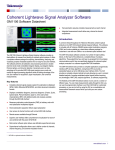
The following image shows a QAM measurement setup. The plots can be
moved, docked, or resized within the application work space or into
separate windows on the desktop. You can display or close plots to show
just the information you need.
The Measurements tab- a summary of all measurements in one place
Make measurements faster
The OMA software is designed to collect data from the oscilloscope and
move it into the MATLAB workspace with extreme speed to provide the
maximum data refresh rate. The data is then processed in MATLAB to
extract and display the resulting measurements.
Take control with tight MATLAB integration
Since 100% of the data processing occurs in MATLAB, test engineers can
easily probe into the processing to understand each step along the way.
R&D labs can also take advantage of the tight MATLAB integration by
writing their own MATLAB algorithms for new techniques under
development.
QAM measurements on the OMA software.
Use the optimum algorithm
In addition to the numerical measurements provided on individual plots, the
Measurements tab provides a summary of all numeric measurements,
including statistics.
Don’t worry about which algorithm to use. When you select a signal type in
the OMA software (for example, PM-QPSK), the application applies the
optimal algorithm for that signal type to the acquired data. Each signal type
has a specially designed signal processing approach optimized for that
signal. This means that you get results right away.
Don’t get stymied by laser phase noise
Signal processing algorithms designed for electrical wireless signals don’t
always work well with the much noisier sources used for complex optical
modulation signals. Our robust signal processing methods tolerate enough
phase noise to make it possible to test signals that would traditionally be
measured by differential or direct detection such as DQPSK.
www.tektronix.com 3