1
APPENDIX E
Glossary
DoseUQ, ProjDoseUQ:
The Noise Dose is the averaged A-weighted Noise Level (taking the
Threshold Level into account) with Time Weighting U = F or S and Exchange
Rate Q = 4, 5 or 6 for an 8 hour period (reference duration) relative to the
maximum allowed (the Criterion Level) – expressed in percentage.
Example: If the Criterion Level is 90 dB and a person is exposed to a constant
average sound level of 90 dB for 8 hours with Time Weighting S and
Exchange Rate 5, then the DoseS5 is 100%. A constant level 95 dB results
in a DoseS5 of 200% and a constant level of 85 dB results in a doseS5 of
50%.
The Projected DoseS5 is the Noise DoseS5 based on measurement duration
less than 8 hours, assuming the sound level for the remaining time stays the same.
E:
Sound Exposure is the energy of the A-weighted sound calculated over the
measurement time. The unit is Pa2h.
Exchange Rate:
Exchange Rate is the increase in noise level that corresponds to a doubling
of the noise level. The Exchange Rate is used for calculation of LavUQ, TWA,
TWAv, DoseUQ and ProjDoseUQ, where U = F or S and Q = Exchange
Rate: 4, 5 or 6 dB.
Note: LAeq is always based on an Exchange Rate = 3.
Exposure Time:
Exposure Time is the actual time that a person is exposed to noise during
a workday. Used for calculation of Lep,d and Lep,d,v.
‘F’, ‘S’ or ‘I’ time
weighting:
A time weighting (sometimes called a ‘time constant’) defines how the
exponential averaging in root-mean-square (RMS) measurement is done. It
defines how the heavily fluctuating sound pressure variations are smoothed
or averaged to allow useful readings. The standards define three time
weightings: F (Fast), S (Slow) and I (Impulse). Most measurements are
carried out using the ‘F’ time weighting, which uses a 125 ms time constant.
Frequency:
The number of pressure variations per second. Frequency is measured in
hertz (Hz). The normal hearing for a healthy young person ranges from
approximately 20 Hz to 20000 Hz (20 kHz).
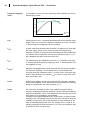
Frequency weighting:
Our hearing is less sensitive at very low and very high frequencies. In order
to account for this, weighting filters can be applied when measuring sound.
The most commonly used weighting is the ‘A-weighting’, which approximates
the human ear’s response to low – medium noise levels.
247