1
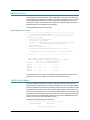
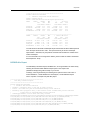
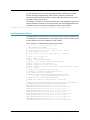
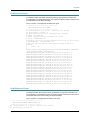
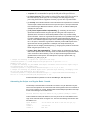
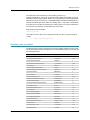
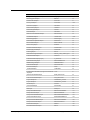
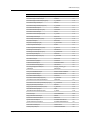
DPARAM File If the dparam forcedesign flag is set to 1 and if extratrunkpenalty>=100 and the nodeparam flag BLOCKTRUNK is off, then trunks are allowed to be added to nodes whose NNI_Bw limit has been exceeded. This extratrunkpenalty is added to the new trunk as cost (in US Dollars) to decrease the possibility of being used. Default value=0. fixfat and fatpct To reserve part of the link bandwidth for future growth or other reasons, the user may use the parameters fixfat and fatpct to define the amount of bandwidth to be reserved on each link. The parameter fixfat allows you to indicate the reserved bandwidth amount using a specific number, while fatpct expresses the reserved bandwidth as a percentage of the total bandwidth. Both parameters may be used together. In situations where only one of them applies, the other parameter should be set to zero. The amount of bandwidth available for path assignments is determined by the following calculation: link bandwidth - link overhead - fixfat - (link bandwidth * fatpct) Link overhead will vary with the hardware device being used. The fixfat and fatpct parameters will be overridden by any contradicting information in the reserved bandwidth file (rsvbwfile), if specified. Consider using fixfat and fatpct 1) to reserve bandwidth for future growth, 2) to reserve bandwidth as the hardware vendor requests, 3) to reserve bandwidth for potential circuit overhead, or 4) to reserve bandwidth to reduce cell drop ratio and delay Because of the bandwidth allocation algorithm implemented, or bugs in the version of firmware, the hardware vendor may ask you to leave a portion of the bandwidth not used. If your overall link utilization is very high and you are using the bump feature heavily, you should consider reserving bandwidth at large node locations. If you are emulating a hardware switch not currently supported by bbdsgn, or if you have not defined all circuit constraints such as pass through timing, or asynchronous and transparent signaling, these parameters may be used to reserve the bandwidth for per circuit overhead. For ATM, frame relay, and router networks, the user may need to reserve at least 20% of the total bandwidth. Otherwise, the over-subscription nature of packet switching may cause cell drop and delay during heavy traffic. forceCoreRoute The forceCoreRoute parameter is used to turn on or off a special routing constraint involving the node hierarchical levels of “core” and “regular”. When this constraint is turned on, no core->regular-> core routing is permitted. There cannot be in any part of the path a core node going to another core node through regular node(s). Once you begin at or transit through a core node, you can visit any number of core nodes. However, if you then go from a core node to a regular node, you can visit regular nodes but no more core nodes in the rest of the path. If we take ‘r’ to represent a regular node and ‘c’ a core nodes, we could explain the routing restrictions using regular expressions. If forceCoreRoute is turned on, only (r-)*(c-)*(r-)* routing is allowed. (c-)*(r-)*(c-)* routing is not allowed in any part of the path. Copyright © 2015, Juniper Networks, Inc. Parameters in More Detail 13