1
..
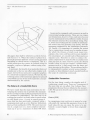
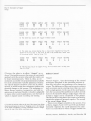
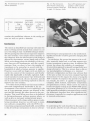
Fig. 1. Three-dimensional
space used to characterize
performance systems.
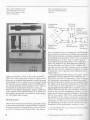
Fig. 2. System architecture.
Distri bution
of decision
making
Level of
decision
making
I/O
Transducers
LSI-ll/2
Microcomputer
SSSP
Digital
Synthesizer
0
File
System
(floppy disks!
+
4 Channels
Audio Output
The Synthesizer
Amount of decision
making
for distinction: physically, where does the decision
making take place? That is, how is the real-time
decision making distributed between the musician
and the machine? Bartlett's system is a good example of musical decision making being divided between the two.
Together, these three criteria define a threedimensional space (Fig. 1) that can be used to characterize performance systems. In terms of this space,
like most of the systems mentioned ours enables the
performer to exercise a fairly high degree of real-time
decision making. In contrast, however, the current
implementation is optimized so as to express control over syntactic structures above the note level.
The composer performs or interprets precomposed
material (in a manner analogous to the role of the
orchestral conductor) rather than articulating the
music note by note (in a manner analogous to that of
an instrumentalist). Finally, in the implementation
to be described, all decision making in this process
remains with the human performer/conductor.
Architecture
A functional block diagram of the system's architecture is presented in Fig. 2. As is shown in Fig. 2, the
main functional units of the system are the control
transducers, the microcomputer, a file system, and
the sound synthesizer.
The synthesizer used in the conduct system (Buxton, Fogels, Fedorkow, and Smith 1978L was developed at the University of Toronto as part of the
research of the SSSP. It is an all-digital device capable of generating complex, high-fidelity audio signals according to well-known synthesis techniques
including additive synthesis (Moorer 1977), VOSIM
(Kaegi and Tempelaars 1978), frequency modulation
(Chowning 1973L and waveshaping (Le Brun 1978;
Arfib 1978). Through the use of time-division multiplexing, it functionally achieves 16 oscillators,
each of which has a sampling rate of 50 KHz. The
output of these oscillators can be routed to one of
four audio output channels.
The Computer
In selecting a computer upon which to base the
system, we were guided by the constraints of costeffectiveness, portability, and a reasonably high
computational bandwidth. While existing 8-bit microprocessors were compact and affordable from a
hardware point of view, they had neither the required computational power nor the software tools
we felt were required. This latter point was of particular importance in terms of cost-effectiveness
from the software point of'view. We already had a
large investment in software running on our PDP11/45 (DEC 1973L so the optimal choice would be
downward compatible with our existing system. We
chose the DEC LSI-ll/2 (DEC 1976). Not only did
this allow us to run existing programs on the smaller
processor, but it also enabled us to continue writing
all new software in a high level language ("C") (Ker-
Buxton, Reeves, Pedorkow, Smith, and Baecker
9