1
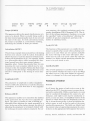
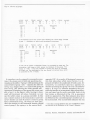
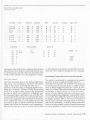
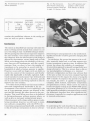
Fig. 14. Summary of cursor
button functions.
BUTTON
Z
1
2
3
VARIABLES
drag
~xJy
last-typed
set default
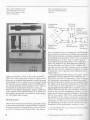
Fig. 15. The microcomputer-based conducting
system in action. From left
to right: W. Buxton, slider
CONTEXT
SWITCHES
change state
"mouse"
N/A
N/A
box, CRT terminal, and
graphics tablet (cursor
with buttons in hand).
CONTROLS
clear
mode ~
last-typed
clear
emulate the parallelism inherent in the analog systems we were so quick to abandon.
Conclusions
The system as described has stood up well under the
abuses of being moved around from concert to concert. One thing is clear: such field testing is invaluable for gaining the information required to improve
the user interface. One simply cannot simulate in
the laboratory how the effectiveness of the design is
affected by nervousness, sweaty hands, and so forth.
While we are happy about the reliability of the system, there are still inadequacies with the control
structure. First, we chose to limit the number of
transducers to be somewhat in accord with the
bandwidth of which a human operator is capable.
However, we are still not happy with our ability to
switch the context of the transducers and thereby
enable this bandwidth to be fully exploited. Additional transducers (such as piano-type keyboards and
touch-sensitive devices), the use of presets, and the
use of cross-fades are also being explored in order to
improve the user interface.
Two other major problems are the limited address
space and computational bandwidth of the microcomputer. One solution we are exploring is the
use of a two-processor system: one devoted to the
user (and file system); the other devoted to the synthesizer. This would allow score data to be buffered
in during performance without spurious effects, as
well as give us increased computational power.
Other processors with a larger address space are also
being considered; however, we still want to maintain software compatability with the PDP-Il/45.
Concerning computational bandwidth, one problem
is that all envelope interpolation is done in software
20
(there being no ramp generators in the synthesizer).
Significant benefits could be gained by changing this
situation.
In conclusion, the system has proven to be a reliable, musically useful tool: a tool that warrants performer investment in practice time. In addition, the
system has shown the viability of considering
downward (as opposed to upward) compatibility as a
design alternative. That is, a system that is able to
use pseudographics techniques on a minimal
hardware configuration and that runs software that
is the same as that run on a host computer has been
demonstrated. In this regard, the choice of using the
PDP-ll family of computers has proved to be a good
one. Finally, the LSI-ll is capable of supporting a
complete, albeit reduced, stand-alone composition
and performance system, which can be run under a
locally developed version of the MINI-UNIX operating system (Hudyma 1979). Given the poor software
tools generally available for microprocessor systems,
the techniques described here have significant implications, especially for complex applications such
as musical performance.
Acknowledgments
In undertaking the work described in this paper, we
were greatly aided by several colleagues. In particu-
A Microcomputer-based
Conducting
System