1
stay behind as much as conventional paragliders do, the low speed is more
likely to cause a stall. Besides, you should always be able to land safely in
case of engine malfunction, so it’s better not to take unnecessary chances and
always fly with a safe margin of speed. Depending on the power unit geometry,
it is possible that after take-off you will notice a propeller torque (turning
moment). It will try to turn you around, so be counter-steer it with a brake or
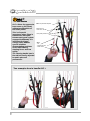
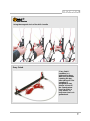
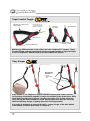
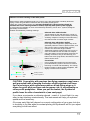
harness cross-bracing. In Synthesis2 there is our TEA system present, making
possible to counter the torque in case there is no cross-bracing. To make TEA
work properly you should assembly the line on proper side (as of propeller
direction) and adjust the blocking knot accordingly to torque force. When
climbing steeply with slow trim settings and high power output beware of the
possibility of stall. Due to typical PPG feature - considerable vertical distance
between thrust axis and wing chord - the range of safe power operation is
closely connected to your skills and equipment.
Power-unit induced oscillations Certain configurations of engine weight, output
and propeller diameter can cause serious oscillations, during which the pilot is
being lifted to one side by the torque effect, swings down due to his weight,
then is lifted again and so on.
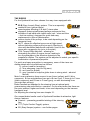
To avoid this you can:
+
change the throttle setting and/or
+
adjust the cross bracing to counteract the torque, if there is one present
and/or
+
use the TEA, pulling down the knot through the tube, simultaneously
blocking it in the slit and/or
+
shift yourself to the other side of the harness and/or
+
change the trimmer setting.
The best method is to fasten opposite cross-bracing, or apply some weightshift. Such oscillations usually occur at full power - the greater the engine
output and propeller diameter, the bigger the swings. In addition there are often
too late or wrong pilot reactions, increasing the problem instead of solving it.
In this case the safest way to deal with this question is to close the throttle and
release the brakes.
Especially less-experienced pilots tend to overreact. This is called a pilotinduced oscillation, and proven solution is to leave the brakes alone.
3.3.2 LEVEL FLIGHT
Once you have gained safe height after take-off and wish to go for a route, you
can turn onto the right direction, fully open the trimmers and let off the brakes.
If the conditions are turbulent, it can look foolhardy, but this is the essential
feature of the reflex profile - the faster you fly, the the safer your Synthesis2 is.
That's why it’s truly possible to release the brakes and enjoy your flight.
18