1
6.2 Aquatic Habitats
General
In the H221 laboratory the Aquatic Habitat Fish System (AH) occupies the entire northwall. It is composed 5 5’-AH racks, 4 3’-AH racks and 2 4’-Zebrafish modular units
(Marine Biotech). It has a total water capacity of 3730 L (927 gal.) with available tank
sizes of 1.5 L, 2.0 L (Zmod only), 2.8 L, and 9.0 L. The 2.8 L and 9.0 L tanks are
interchangeable as are the 1.5 L tanks with the appropriate manifold. All fish tank water
lines have individual adjustment valves on the manifolds above the tank. The total
number of tanks varies greatly depending on the tank sizes and arrangements being used,
but it commonly supports 350-400 tanks. AH tanks must be used with appropriate lids
and baffles.
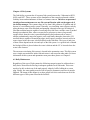
A 2 HP Baldor pump draws water from the sumps and delivers it to two canister bag
filters. The first canister is a particle prefilter with a 50 micron felt bag filter, the second
canister is a 50-micron bag filter with carbon and coral media. Water is then sterilized by
a 390 watt UV (6-65 watt bulbs) before entering the fish tanks. Water from the fish tanks
drain down a gutter and passes through a polystrand filter before entering the sump below
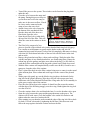
the fish rack. Water in the sump
J
K
M
moves through a Siporax biological
H
G
filter and is aerated by diffuser
I
powered by an air pump above the
canister filters, see figure 6.0. Water
D
is then drawn back to the pump. The
system generally runs at 35-45 gpm.
E
F
The system receives a 5% water
exchange (~50 gallons) from the
C
water tower every day via a timer,
metering pump, and solenoid valve
A
system located next to the water
B
tower. The timer turns on at 10:00
Figure 6.0 A) Valve connecting the sump to the pump.
AM off at 12:00 PM.
Maintenance
B) Pump C) Valve to prevent back flow during pump
replacement. D) Canister shut off valve #1 E) Prefilter
canister. F) Carbon filter canister. G) System bypass
valve. H) Canister shut off valve #2. I) Filter bypass
valve. J) Low-level pump shut off relay box. K) Air
pump platform. L) Pressure gauge. M) Pump power
switch.
Daily
Water Flow and Drainage. On a
daily basis individual tanks are
inspected by staff to insure adequate water flow and proper drainage. Smaller tanks (1.5
L-2.8 L) have a single water line while larger 9.0 L tanks have two. Each tank needs a
water exchange of 6 turns an hour (6 times the water volume of the tank). This can be
accomplished by adjusting the tanks water supply valve(s) to a steady but not brisk
stream of water. Brisk streams of water can overflow the tank possibly leading to fish
loss. Tanks with too little or no water supply can produce toxic levels of waste. Baffles
located at the back of the tank need to be inspected for excessive biofluc buildup that can