1
MISO- High-T self-recording fluid temperature loggers - Manual 8/25/06
2
1. Introduction
D. Fornari at WHOI helped to initially develop (with M. Olsson at DeepSea Power & LightDSPL) high-T ‘Hobo’ fluid temperature loggers (~152°C - 417°C) over a decade ago, and DSPL
provided them for many users in the oceanographic community for the past 10 years. These self
recording loggers (Figures 1 and 2) are rated to 6000 m operating depth and have been pressure certified
for use on Alvin. They have been used extensively and successfully at hydrothermal vents in the Pacific
and Atlantic Oceans by numerous investigators over the years and the results have been published in
numerous journal articles including: Fornari et al., [1996, 1998, 2003, 2004]; Fornari and Shank, [1999];
Langmuir et al., [1996]; Shank et al., [1998, 2001]; Sohn et al., [1998, 1999, 2005, in press]; Scheirer et
al., [2006]). These types of loggers are currently in use at the East Pacific Rise 9° 50’N and the Juan de
Fuca Ridge – Main Endeavour Field ISSs, and will be deployed in the Lau Basin in Fall, 2006 (C. Fisher,
Penn State. U.).
Over the past two years, since DSPL stopped manufacturing these loggers and turned over to
WHOI-MISO the drawings and related assembly and supplier information, I have provided refurbishment
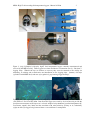
and supply services to various users. Two styles of loggers exist, as shown in Figures 1 and 2. The most
recent (spherical housing) style has two Onset™ 32k recording chips, and a pressure barrier between the
housing and the tip, that provides shipboard capability for refurbishment and redeployment as long as
adequate supplies are on hand. The older style, cylindrical housings have been modified so that they now,
too accommodate two Onset™ 32k recording chips. The main difference is that the old style cannot be
refurbished at sea while the new ones can. The old style can be refurbished back at WHOI.
These loggers remain the only readily available, and relatively inexpensive self-recording high-T
vent fluid temperature loggers, and they have provided important time-series information to R2K
investigators working at various ISS sites. Most recently these loggers captured the 2005-2006 EPR
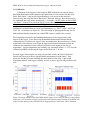
eruption at 9° 50’N (K. Von Damm, pers. commun., unpubl. data, 2006) (Figure 3).
B
A
C
D
F
E
E
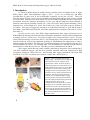
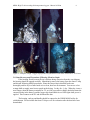
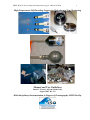
Figure 1. New-style (spherical housing)
high-T logger. A) shows interior of spherical
housing with 2 Onset™ computer chips
(green wafers) visible. B) shows probe tip
and housing (quarter for scale reference). C)
RTD elements shown, lower one is raw RTD
and upper two are encased in ceramic plug.
D) loggers shown with polyethylene covers
which also serve to attach syntactic foam for
floatation. E-F) drawings of internal and
external views of spherical high-T loggers
showing location of Swage pressure fitting
that seals tubing from the housing where the
computer chips are stored. This
configuration provides the ability to service
the loggers at sea and replace tips that may
have had to be broken off in chimney walls.
In this case, the Ti tubing tips are replaced,
as are the RTD elements and connector, and
the unit can be placed back into service on
the same cruise.