1
Low-Pass Anti-Aliasing Filter
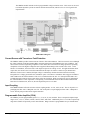
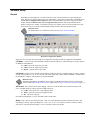
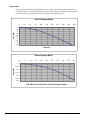
Each channel features a programmable low-pass filter to provide alias protection and to allow for the removal of
undesired frequencies from the measured response. This filter is configurable within 3 modes: 8-pole, 2-pole, and
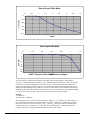
Bypass. The 8-pole Butterworth switched capacitor filter offers the greatest alias protection and is most commonly
used in vibration measurements. Its –3dB cutoff frequency is settable from 10 Hz to 50 kHz in a 1-2-5 progression.
Application information regarding the proper setting of this filter is provided in Maximizing Alias Protection.
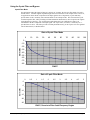
2-pole mode utilizes two RC filters in series. Its –3dB cutoff frequency is settable as well from 10 Hz to 50 kHz in
a 1-2-5 progression. It provides tighter amplitude and offset accuracy than 8-pole mode at the expense of reduced
alias protection (due to its more gradual roll-off). It is most commonly used in proximity sensor measurements,
where the DC component of the input signal is critical. Additionally, the filter can be bypassed altogether, resulting
in a signal bandwidth of up to 200 kHz.
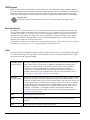
When the LPF (Low Pass Filter) is in the Bypass mode, the bandwidth of the system depends on the coupling mode
selected. For the 0.1 Hz and 10 Hz selections, the bandwidth is approximately 190 kHz. For the DC selection, the
bandwidth is approximately 130 kHz. For the 25 V range, the bandwidth is approximately 120 kHz.
Reference Note:
Application information regarding the 2-pole and Bypass settings of the filter is provided in the section
entitled, Using the 2-Pole Filter and Bypass (page 11).
Overrange Detection
Each WBK18 channel is equipped with overrange detection circuitry. Use of this feature insures that all data
collected during an acquisition did not exceed a user-specified level, set as a percentage of range. In its most
common use, with the level set to 100%, the user is notified if the input signal exceeded the input full-scale range,
even momentarily. This protection is critical, for overrange signals result in clipped data that significantly corrupts
FFT analysis. This error is communicated to the user via a front panel LED and is also available through a software
status request at the end of an acquisition. When recognized, an error is latched until the commencement of a new
acquisition. Consequently, even intermittent faults are detected and communicated. However, an overrange event
does not stop the acquisition process or change the data, providing the user with full control over the disposition of
data.
An extension of the overrange capability could involve its integration into a process monitor application, whereby
the fault condition is used to monitor the stability of a previously characterized dynamic signal. The overrange level
is programmable from 1 to 100% of range on a per WBK18 basis. Overrange detection can be enabled or disabled
on a per channel basis.
Simultaneous Sample and Hold
All WBK18 channels are sampled simultaneously, after which the WaveBook measures each output until all
channels are digitized. The time-skew between sampling on all channels is 100ns, regardless of the number of
WBK18s connected to the WaveBook. This maximizes channel-to-channel phase matching.
When using WaveBook with an SSH channel enabled, the per-channel sample rates are reduced.
The rate reduction is the same as that which would occur if another channel were added. The
per-channel rate (with SSH enabled) is:
1 MHz / (n+1), where n is the number of active channels.
WBK18, Dynamic Signal Input Module
926896
WBK18, pg. 3