1
6
2 Storing XML documents in databases
As the aim of this project is to store XML documents in the existing AMOS II database, we
shall briefly look at some simple methods commonly used to achieve this in relational
database environments. Both of the following ideas are outlined in [Bour99a].
2.1 Table-Based Mapping
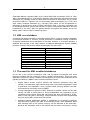
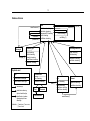
This approach uses a mapping of simple XML documents to one or more tables:
<A>
<B>
<C>ccc</C>
<D f=”111”>ddd</D>
<E >eee</E>
</B>
<B>
<C>fff</C>
<D f=”222”>ggg</D>
<E>hhh</E>
</B>
<F>
<G>iii</G>
</F>
</A>
Table
docId
635
635
…
B
C
ccc
fff
…
Table
docId
635
…
F
G
iii
…
D
ddd
ggg
…
f
111
222
E
eee
hhh
…
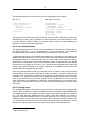
The advantage of this mapping is its simplicity that leads to good performance even in
large-scale environments. However, arbitrary XML structures cannot be expressed with this
approach, i.e. further nesting of elements is not possible.
2.2 Object-Relational mapping
The Object-Relational approach is typically used in XML-enabled relational databases or
middleware tools (e.g. mapping of Entity Beans in EJB to an RDBMS). With this method, an
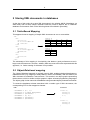
XML document is treated as a tree structure. This results in an object graph representing
the document, which is similar to object graphs in object-oriented programming languages.
The object graph is then stored in the database using standard object persistence methods.
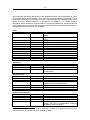
To create the database schema associated with a certain type of XML documents, the
corresponding DTD is first mapped to classes:
DTD
<!ELEMENT
<!ATTLIST
<!ELEMENT
<!ELEMENT
<!ELEMENT
<!ELEMENT
Classes
A
A
B
C
D
E
(B | C)>
F CDATA #REQUIRED>
(#PCDATA)>
(D, E)>
(#PCDATA)>
(#PCDATA)>
class A {
String b;
String f;
C c;
}
class C {
String d;
String e;
}