1
5.1 Newton’s First Law
Section Summary
●
The concept of inertia explains the resistance of mass to acceleration.
●
Newton’s first law extended and developed Galileo’s ideas about inertia.
●
Newton’s first law can be applied in many situations.
Galileo’s Insight
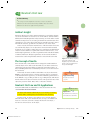
Imagine an ideal version of the situation in Figure 5.2, in which no friction
acts on the sled and no air resistance acts on the athlete. Scientist Galileo
Galilei (1564–1642) thought that an object moving on a level surface would
continue moving forever at constant speed and in the same direction if no
external force acts on the object. If the object is initially stationary, then it
will remain stationary, provided no external force acts on the object.
In the everyday world, the external forces of friction and air resistance
act on all moving objects. So an object that is in motion will eventually
slow down to a stop, unless another force acts to compensate for both friction
and air resistance. Galileo recognized the existence of these forces, so he
used thought experiments, as well as experiments with controlled variables,
to understand motion. Thought experiments are theoretical, idealized
situations that can be imagined but cannot be created in the real world.
The Concept of Inertia
Since ancient times, many thinkers have attempted to understand how
and why objects move. But it took thousands of years before satisfactory
explanations were developed that accounted for actual observations. A
major stumbling block was not identifying friction as a force that exists in
the real world.
In his study of motion, Galileo realized that every object has inertia.
Inertia is a property that resists a change in motion such as acceleration
or deceleration. From experience, you would confidently predict that it is
more difficult to stop a rolling car than to stop a rolling bicycle. This means
that the inertia of an object is related to its mass. The greater the mass of the
object, the greater its inertia. Mass, then, is a measure of inertia.
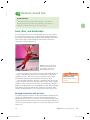
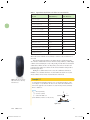
Figure 5.2 This athlete, competing
in the mens’ skeleton at the
Olympics, keeps air resistance and
friction as low as possible so that
his speed remains high.
PHYSICS• SOURCE
Suggested Activity
●
B6 Quick Lab Overview on
page 129
Newton’s First Law and Its Applications
Newton modified and extended Galileo’s ideas about inertia in a law,
called Newton’s first law of motion.
An object will continue either being at rest or moving at constant
velocity unless acted upon by an external non-zero net force.
PHYSICS• SOURCE
Explore More
Why did Newton need to modify and
extend Galileo’s ideas about inertia?
In other words, an object at rest will stay at rest, and an object in
uniform motion will stay in uniform motion, as long as no unbalanced
force acts on it. So if you want to change the motion of an object, a
non-zero net force must act on the object.
©P
05-PHYSICS-11SE-Ch05.indd 127
Chapter 5 Forces can change velocity.
127
7/23/10 11:37:07 AM