1
Appendix: Equations Used in Deconvolution
Appendix: Equations Used to Deconvolute DSC Data
I. Independent Transitions
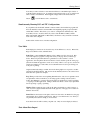
It will be assumed here that a protein (or other macromolecule) is composed of a number
of structural domains A, B, C, ..., each of which is involved independently in a transition
between the folded and unfolded forms (A = A'
, B = B'
, ...). Equilibrium constants will
be expressed as fractions (KA = fA'/fA, KB = fB'/fB, ...) with the usual designation for the
actual (i.e., calorimetric) molar enthalpy changes (∆HA, ∆HB, ...).
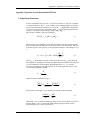
The total molar enthalpy of the system H will be
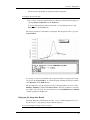
H = H N + f A '∆H + f B '∆H B + ...
(1)
The first term for the totally native form where all domains are in their folded state, HN,
must be included since all ∆H values are measured relative to the folded form. The total
molar heat capacity of the system Cp is the temperature derivative of the enthalpy in eq 1,
so
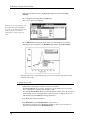
C p = C pN + f A '∆C pA + ∆H A
δf A '
+...
δT
(2)
where CpN is the molar heat capacity of the totally folded state, ∆CpA is the change in
heat capacity for unfolding the A domain, and where the term in brackets will be repeated
for each domain involved in unfolding. Remembering that fA = 1 - fA', then the
fractional concentration of the primed species can be readily expressed in terms of the
corresponding equilibrium constant
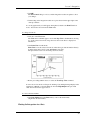
f A' =
KA
1+ KA
(3)
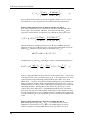
which can then be differentiated to give
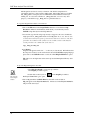
δf A '
=
δT
KA
(1 + K A ) 2
δ ln K A
δT
(4)
The derivative on the right of eq 4 is known from elementary thermodynamics
δ ln K A
∆H A∗
=
δT
RT 2
(5)
where ∆HA* is the so-called van'
t Hoff heat change for the reaction which corresponds to
the heat change for the cooperative unit which actually participates in the reaction.
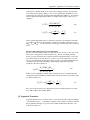
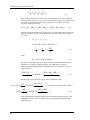
Substituting from eq'
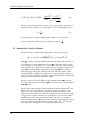
s 3-5 into eq 2 then gives
65