1
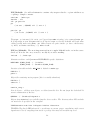
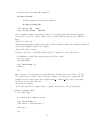
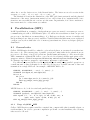
• Return after return, exit all loops and go to main program, which must save needed global
variables to file. The only difference with normal exit is that temporary files are kept,
while files in portable format are not saved.
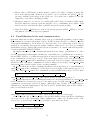
• if variable restart is set in input:
– starting potential and wavefunctions are read from file
– each routine containing a loop checks for the existence of a restart * file before
starting its loop
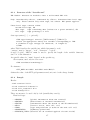
As of April 2013 only the electronic loop is organized ths way. Loops on nuclear positions will
be organized in the same manner once their re-organization is completed. To be done:
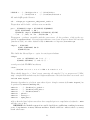
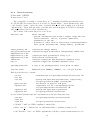
• wg and et should be read from data file
• rho(+paw/U/metagga info) should be written to and read from unformatted data file
similar to the file used in mix rho; portable format should be written only at convergence.
7
Format of arrays containing charge density, potential,
etc.
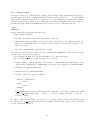
The index of arrays used to store functions defined on 3D meshes is actually a shorthand for
three indices, following the FORTRAN convention (”leftmost index runs faster”). An example
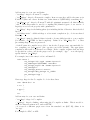
will explain this better. Suppose you have a 3D array psi(nr1x,nr2x,nr3x). FORTRAN
compilers store this array sequentially in the computer RAM in the following way:
psi(
1,
1,
1)
psi(
2,
1,
1)
...
psi(nr1x,
1,
1)
psi(
1,
2,
1)
psi(
2,
2,
1)
...
psi(nr1x,
2,
1)
...
...
psi(nr1x,nr2x,
1)
...
psi(nr1x,nr2x,nr3x)
etc
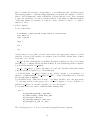
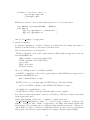
Let ind be the position of the (i,j,k) element in the above list: the following relation
ind = i + (j - 1) * nr1x + (k - 1) *
nr2x * nr1x
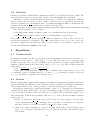
holds. This should clarify the relation between 1D and 3D indexing. In real space, the (i,j,k)
point of the FFT grid with dimensions nr1 (≤nr1x), nr2 (≤nr2x), , nr3 (≤nr3x), is
rijk =
j−1
k−1
i−1
τ1 +
τ2 +
τ3
nr1
nr2
nr3
21