1
2.
Operation
2.1
Principles of Reverberation
Artificial reverberation models tend to fall into two main types, which can best be described
as convolution and reflection simulation modelling. Both processes seek to achieve a degree
of realism and virtual space by modelling room characteristics. The convolution model
achieves this by recording the actual impulse response (due to reflections and dispersion) of
existing spaces, and imposing the resulting transfer characteristic onto the programme to
reproduce the character of the space. However this model does not lend itself easily to the
user interaction required for the artistic creation of reverberation effects that are commonly
needed in production. Another important factor is that the user cannot readily simplify a
convolution model to avoid conflicts that often occur between the recorded ambience and the
simulated reverb.
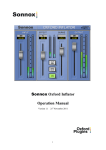
The Sonnox Oxford Reverb belongs to the reflection simulation type, as this allows the wide
and varied user control intended from this device, in the pursuit of a high degree of artistic
interaction and creative freedom.
3