1
GeoModeller User Manual
Contents | Help | Top
Tutorial case study J (Geothermal)
2
| Back |
In this case study:
•
Case Study J Introduction
•
Course Structure
•
Tutorial J1: Load the HotRox 3D GeoModeller Project
•
Tutorial J2: Examine the Project Geology and the 3D Geology Model
•
Tutorial J3: Geo-register the Geology Map
•
Tutorial J4: Add Geology 1—Create a Formation, Update Stratigraphy
•
Tutorial J5: Add Geology 2—Digitise and Recompute the Model
•
Tutorial J6: Import Drillhole Data and Recompute the Model
•
Tutorial J7: Add geothermal physical property data
•
Tutorial J8: Compute geothermal solutions
•
Case Study J References
Case Study J Introduction
Parent topic:
Tutorial case
study J
(Geothermal)
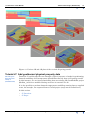
In this case study we calculate the equilibrated, steady state temperature
distribution of the modelled geology in our project area. Given certain assumptions
and boundary conditions (described below), the distribution of resulting in-situ
formation temperatures is related to the 3D distribution of lithologies in our model,
and their related thermal properties (thermal conductivity and heat production rate).
At present the geothermal module accounts for heat contributions from conductivity
and internal heat production. This is considered to be adequate for many geological
settings involving ‘hot dry rock’ geothermal resources. However, improved 3D
temperature estimation will be available in the future through implementation of
advection considerations.
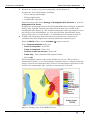
HotRox Project scenario
Geothermal energy company geologists have established from outcrop samples that
the HotRox Project granite has anomalously high heat-producing properties due to its
radiogenic mineralogy (heat production rate of 15 µW/m3). The granite outcrops east
of a major basin-margin fault, but interpretation of seismic and gravity data indicate
that the granite also extends further west beneath the basin sediments in the vicinity
of Section sCC. The Upper Palaeozoic unit of the basin sequence is a fine grained
shale with low thermal conductivity (1.5 W/m/K—based on analysis of samples from
drillhole DDH3 on Section sCC). This shale unit is potentially a thermal insulator.
With encouraging results from heat flow data and geothermal gradients measured in
drillhole DDH3, the company has begun a 3D geology and temperature modelling
study to:
Contents Help | Top
•
Investigate the geothermal potential of their tenement, and to
•
Estimate the total heat resource of their project ‘volume’
© 2013 BRGM & Desmond Fitzgerald & Associates Pty Ltd
| Back |