1
The code is written specifically for IEEE 802.3
Ethernet packet encapsulation (RFC 894), IPv4
protocols.
The code interfaces seamlessly with the
COM-5401SOFT Tri-mode 10/100/1000 Mbps
Ethernet MAC for the MAC / PHY layers
implementation. However, the MAC interface is
generic and simple enough to interface with any
Ethernet MAC component with minimum glue
logic.
The component’s very efficient implementation
makes it suitable for instantiations within a small
FPGA. The baseline IP router uses 28% of a Xilinx
Spartan-6 LX45.
Principle of operation
Concept
The IP frame maximum size (maximum
transmission unit (MTU)) is 1500 bytes. No
datagram fragmentation is necessary nor used.
The IP frames are then encapsulated within a bitserial or byte-wise HDLC frame, one packet per
frame. A 16-bit CRC is inserted at the end of each
frame to detect errors upon reception. HDLC
encoding transmits empty frames when no payload
data is available.
Bit-serial HDLC frames can be subsequently
scrambled with a V.35 scrambler to ensure balance
between 0's and 1's and guarantee bit transitions (for
a well behaved modulated spectrum and to assist
demodulator acquisition when applicable).
The resulting stream is then sent to the WAN over a
continuous link, typically using a modem.
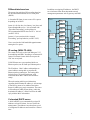
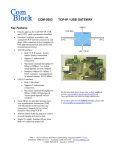
The COM-5404 forwards IP frames from a RJ-45
10/100/1000 Mbps LAN interface to a clocksynchronous modem interface and vice versa. The
interface can be 1-bit serial or 8-bit parallel.
The reverse process is performed at the receiving
end. Erroneous packets which do not pass the CRC
test are rejected.
The IP frames received over the LAN are stripped
of their link layer information: Ethernet source
address, destination address and type are removed,
keeping only the IP fields.
IP forwarding
TCP, UDP, ICMP and IGMP packets are processed
since they are transmitted as IP datagrams.
Non IP frames are rejected.
IP frames whose Time-To-Live field has reached
zero are discarded. For the other packets, the TTL is
decremented.
Limited broadcasts (those with destination IP
address 255.255.255.255) are not forwarded.
The COM-5404 implements Differentiated Services
(DiffServ) whereby IP forwarding from LAN to
WAN is prioritized on the basis of the IP frame
DSCP field. Five queues handle different traffic
classes, including Expedited Forwarding (EF) for
low-loss, low-latency, low-jitter frames and four
Assured Forwarding (AF1-AF4) classes. Frames are
discarded without notification if the associated
queue is full.
The forwarding rules are specified in the RFC1812
document “Requirements for IP Version 4 Routers”.
The decision to forward a LAN IP frame to the
remote WAN is based solely on the destination IP
address. To determine whether a frame is destined
to a local (LAN) or remote (WAN) IP address, the
router compares the masked destination address
(Destination IP address & subnet mask) with the
masked router address
(IP router own IP address & subnet mask). When
this comparison is false, the IP frame is forwarded
to the WAN.
Example:
(a) Router IP address: 192.68.0.2
(b) Router subnet mask: 255.255.255.0
(c) Frame destination IP address is 74.54.97.66
Masked frame destination: 74.54.97.0
Masked router address: 192.68.0.0
Since the masked destination does not match the
masked router address, the frame is not for a local
destination. Consequently the router will forward
the frame to the WAN.
2