1
tightened. For changes in pressure, the regulator position and application should be reassessed. It is recommended that joint tightness of
the threaded fastener assembly be checked with suitable measuring
equipment. Follow the national legislation of waste disposal.
Putting Into Service
Air Supply
Use a clean lubricated air supply that will give a measured air pressure
at the tool of 90 psi/ 6.3 bar when the tool is running with the trigger
fully depressed And the air regulator in its maximum opening flow
position. Use recommended hose size and length. It is recommended
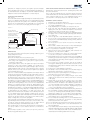
that the tool is connected to the air supply as shown in figure 1.
Safe Rules When Using an Impact Wrench
Read all these safety instructions before operating this product and
save these instructions.
The tool has been manufactured in conformity with the instruction
of EU machine directive. The EU mark will be considered void in the
event of inexpert repairs, the use of non-original parts and in case of
non-observance of the safety instructions in the user’s manual.
General safety rules:
1.
2.
3.
4.
FIGURE 1.
Take air from top
All pipe and fitting
should be 1/2” or larger
5.
Compressor with sufficient
capacity to maintain
recommended working
pressure at each tool outlet
Low spot
to trap
water
Easy to reach and
operate shut off valve
Air tool
Air regulator set at
recommended working
air pressure
Receiver tank
40 gallons or more
Drain daily
Filter lubricator
6.
7.
8.
Drain daily
Recommended air supply system
Operating
The output of the impact wrench in prime working condition is governed by mainly three factors
a)The input air pressure
b)The time the impact wrench is operated on joint.
Normal time for joints of average tension requirement 3 to 5 seconds.
c)The setting of air regulator for a given joint at a given pressure
operated for a given time.
The air regulator can be used to the regulate the output of the impact
wrench if no other control means is available. It is strongly recommended that an external pressure regulator ideally as part of a fitter/
regulator/lubricator (FRL) is used to control air inlet pressure so that the
pressure can be set to help control the tension required to be applied
to the threaded fastener joint.
There is no consistent reliable torque adjustment on an impact wrench
of this type. However, the air regulator can be used to adjust torque to
the approximate tightness of known threaded joint. To set the tool to
the desired torque, select an nut or screw of known tightness of the
same size, thread pitch and thread condition as those on the job. Turn
air regulator to low position, apply wrench to nut and gradually increase power (turn regulator to admit more air) until nut moves slightly in
the direction it was originally set. The tool is now set to duplicate that
tightness, note regulator setting for future use. When tightness nuts
not requiring critical torque values, run nut up flush and then tighten
an additional one-quarter to one-half turn(slight additional turning is
necessary if gaskets are being clamped). For additional power needed
on disassembly work, turn regulator to its fully open position. This
impact wrench is rated a bolt size(please refer technical specification
of tool). Rating must be down graded for spring U bolts, tie bolts,
long cap screws, double depth nuts badly rusted conditions and spring
fasteners as they absorb much of the impact power. When possible,
clamp or wedge the bolt to prevent spring back.
Soak rusted nuts in penetrating oil and break rust seal before removing with impact wrench. If nut does not start to move in three to five
seconds use a large size impact wrench. Do not use impact wrench
beyond rated capacity as this will drastically reduce tool life.
Note: Actual torque on a fastener is directly related to joint hardness,
tool speed, condition of socket and the time the tool is allowed to
impact.
Use the simplest possible tool=to-socket hook up. Every connection
absorbs energy and reduces power.
9.
10.
11.
12.
13.
14.
15.
16.
17.
18.
19.
20.
21.
22.
23.
24.
25.
26.
Watch the tool at all times when in use.
People under the influence of alcohol or drugs are not allowed to
use, repair or maintain the tools.
Keep unqualified persons, children, etc. away from the tool.
Keep work area clean and with sufficient daylight or artificial
lighting. The work area on which the machine is used must be
cleaned up. Disorder is potential cause of accidents.
Danger of explosion. Never use oxygen and combustible gas as an
air supply for the tool which many be ignited by spark and cause
fire or explosion.
Never use gasoline or other flammable liquids to clean the tool.
Do not use air tools in potentially explosive atmospheres such as
in the presence of flammable liquids, cleaning solvents, fluid energy or stored gases.
Do not expose air tools to rain. Do not use air tools in damp or
wet locations.
When a fault or failure is detected, the tool must immediately be
disconnected from the air supply and returned for repair.
It is not permitted to modify the tool in any way.
When not in use, keep tools in a dry place, either locked up or i a
high place, out of the reach of children.
Do not force small air tools to do the job of a heavy-duty task. Do
not use air tool for purpose of which was not intended.
Wear suitable ear protection at environment noise level>80db(A)
and safety spectacles when using the tool. Always wear approved
safety goggles if work in dusty. This also applies to other persons
in the near by vicinity.
Do not wear loose clothing or jewelry. They can be caught in
moving parts. Rubber gloves and non-skid foot wear are recommended when working outdoors. Wear protecti8ve hair covering
to contain long hair.
Keep proper footing and balance at all times.
Use clamps or a vice to hold work-piece. It is safer than using your
hand and free both hands to operate the air tool.
When not use, before performing service or changing accessories
please disconnect tool from air compressor.
Do not carry plugged in air tool with your finger on the switch
trigger. Be sure switch is in the “OFF” position when connecting
to air supply.
Watch what you are doing. Use common sense, even unsafe
situation or unbalanced positions, particularly when you are tired.
Air powered tools can vibrate in use. Vibration, repetitive motions or uncomfortable positions may be harmful to your hands or
arms. Stop using any tool if discomfort, tingling feeling or pain
occurs. Seek medical advice before resuming use.
For multiple hazards, read and understand the safety instructions
before installing, operating, repairing, maintaining, changing accessories on, or working near the assembly power tool for threaded fasteners. Failure to do so can result in serious bodily injury.
Only qualified and trained operators should install, adjust or use
the assembly power tool for threaded fasteners.
Do not modify this assembly power tool for threaded fasteners.
Modifications can reduce the effectiveness of safety measures
and increase the risks to the operator.
Do not discard the safety instructions; give them to the operator.
Do not use the assembly power tool for threaded fasteners if it
has been damaged.
Tools shall be inspected periodically to verify that the ratings and
markings required by this part of EN ISO 11148 are legibly marked
on the tool. The employer/user shall contact the manufacturer to
obtain replacement marking labels when necessary.