1
3
Principle of Operation
This device is intended for downconverion of ion signals from the MHz-range (1 to 40MHz)
down to the LF (low frequency) range of 0…40kHz. It is a multichannel device, which has 2
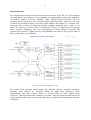
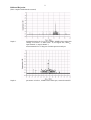
inputs and 8 output channels. Generally the downconversion acts like illustrated in the
following diagram. This process effectively shifts a selected frequency range down towards
zero, bringing the signals of interest to a more convenient, i.e. smaller frequency range. The
amount of frequency shift is defined by the L.O. (local oscillator) frequency. In the FD 1-40
this frequency can be chosen for every output channel individually. The whole device therefore
provides the possibility to examine 8 independent frequency windows (each 40kHz wide) in
the range from 1MHz to 40MHz, all at the same time and in real time mode (without data loss).
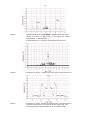
fig. 1: Illustration of a downconversion process. The signal pattern shown is arbitrarily chosen.
Target Application
The envisaged target application is the ion detection via FT-ICR (Fourier-Transform Ion
Cyclotron Resoanance) in a miniaturized EBIT-type Penning ion trap. Unlike conventional FTICR, the cyclotron frequencies are considerably higher, bringing up the neccessity to down
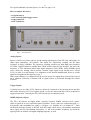
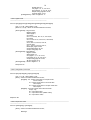
convert all ion signals to lower frequencies. As can be seen in the following illustration, the
down converter forms together with an 8 channel 40kHz-FFT-analyzer a 40MHz FFT analyzer
set up with 8-channel real time capability. Each of the 8 resulting frequency windows
represents a 40kHz wide section of the input signal coming from the ion trap.
fig. 2 : Illustration of the target application, including the 8-channel down converter FD 1-40.