1
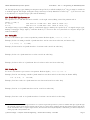
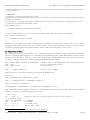
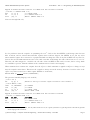
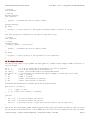
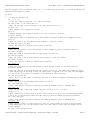
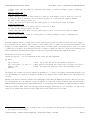
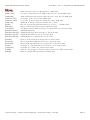
CSE325 Embedded Microprocessor Systems Course Notes :: Part 2 - C Programming for Embedded Systems Advantages to enums, 1. 2. 3. 4. Proper use of enumerated types should improve the readability of the code (when you create an enumerated type in C, you are not really creating a "new type", but rather, an enumerated type is just a mapping from magic numbers to identifiers). enum values can be auto-generated; by default, the values are 0, 1, 2, ..., so this saves a bit of typing. Some compilers can emit a warning if a switch statement does not include cases for all enumerated values. In some IDE's, the editor will syntax color enumerated values. Also, the debugger will display the identifier for the enumerated values rather than the integer values. This last advantage is probably the most useful one. 1.3 Bit Manipulation Operators6, 7 There are six bit manipulation operators in C. 1.3.1 Bitwise AND Operator: & Remember: && is logical AND. uint8_t8 x = 0x3C, y = 0xA5, z; 0011 1100 = 0x3C (x) z = x & y; & 1010 0101 = 0xA5 (y) z &= x; ==> 0010 0100 = 0x24 (z = x & y) 0010 0100 = 0x24 (z) & 0011 1100 = 0x3C (x) ==> 0010 0100 = 0x24 (z &= x) 1.3.2 Bitwise OR Operator: | Remember: || is logical OR. uint8_t x = 0x3C, y = 0xA5, z; 0011 1100 = 0x3C (x) z = x | y; | 1010 0101 = 0xA5 (y) z |= x; ==> 1011 1101 = 0xBD (z = x | y) 1011 1101 = 0xBD (z) | 0011 1100 = 0x3C (x) ==> 1011 1101 = 0xBD (z |= x) 1.3.3 Bitwise Complement Operator: ~ Forms the one's complement of the operand. uint8_t x = 0x3C; z = ~x; ~0011 1100 ==> 1100 0011 = 0xC3 1.3.4 Bitwise Exclusive-OR (XOR) Operator: ^ | is called the bitwise inclusive-OR operator. Exclusive-OR is 0 if the operands are the same and 1 if the operands are different. uint8_t x = 0x3C, y = 0xA5, z; 0011 1100 = 0x3C (x) z = x ^ y; ^ 1010 0101 = 0xA5 (y) z ^= x; 1001 1001 = 0x99 (z = x ^ y) 1001 1001 = 0x99 (z) ^ 0011 1100 = 0x3C (x) ==> 1010 0101 = 0xA5 (z ^= x) 1.3.5 Bitwise Shift Left Operator: << The operation a << n will shift the bits in variable a to the left n times filling new bit positions with 0. uint8_t x = 0x3C, z; z = x << 3; z <<= 2; 0011 1100 << 3 ==> 1110 0000 = 0xE0 1110 0000 << 2 ==> 1000 0000 = 0x80 On unsigned integer types consisting of b-bits, shifting a left by n will multiply a by 2n, but you must be careful to avoid the overflow which will occur when a << n is too large to be represented in b-bits. Overflow can be avoid by ensuring that a · 2n 2b - 1 or a (2b - 1)/2n. Example, a is a uint16_t variable and we wish to multiply a = 14,567 by n = 16 = 24 using the left-shift trick. Will this result in overflow? To avoid overflow, it must be true that a (2b - 1)/2n or 14,567 (216 - 1)/24 or 14,567 4095.9375, which is false; therefore, overflow will occur. 6 7 8 http://www.cprogramming.com/tutorial/bitwise_operators.html http://en.wikipedia.org/wiki/Bitwise_operations_in_C typedef unsigned char uint8_t; See "global.h" in newbbproj.zip. (c) Kevin R. Burger :: Computer Science & Engineering :: Arizona State University :: Fall 2015 Page 2