1
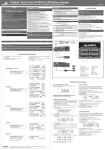
SPECIFICATION
Input:
230V~50Hz OR 12V car battery 12.6V DC
- 0% / +15%
Outputs:
OUTPUT sockets: 1A-2A-4A (fast charge
adjustable by means of a slide switch)
Balancer: maximum - 140mA per cell
Transmitter or Receiver: 150mA
Charging indicators: 3 LEDs RED fast charge
(LEDs flash after charging process
completed)
Transmitter or receiver (150mA)
Power indicator: LED YELLOW
Discharge: LED GREEN
Protection: Each output has a short-circuit and
overcurrent protection
Over charging protection for Output socket.
SAFETY MEASURES AND PRECAUTIONS
• The charger must be protected against high humidity
and water.
• Do not operate charger at environment temperature
higher than 40°C.
• Do not fast charge a hot battery pack - let it cool down
naturally before starting the next charging process.
• Do not cover the cooling slots. The unit can get very
warm when in charging.
• Allow the charger to cool down after two fast charging
cycles 4A or 2A.
• For NiCd/NiMH batteries do not recharge the battery
pack unless it is completely discharged.
• Never leave the charger unattended!
• If the battery gets hot (>45"C) remove it from the
charger immediately. Otherwise, it may cause risk and
explosion! When the battery pack has reached a
temperature of 45°C, it must be considered as fully
charged. Do not charge a hot battery.
• Charge only NiCd, NiMH LiFe or LiPo batteries. Do
not attempt to charge lead-acid and Li-Ion batteries or
primary disposable cells.
• Make sure to select correct mode before charge.
Charging with wrong mode may cause risk explosion!
• Connect the charger only to appropriate voltage
sources (230V~50Hz mains socket or 12V DC
cigarette lighter socket).
• Never connect the charger to the 230V~50Hz socket
AND the 12V DC socket at the same time, otherwise
it will be damaged.
• Repairs may only be carried out by authorized service
centres.
• CAUTION explosive gases, avoid open fire and
sparks!
• Keep the charger out of reach of children.
• Never plug in the charger if there are any signs of
damage to the housing, cables, connectors or mains
plug. Never try to open the charger.
• Set the fast charge current 1A - 2A - 4A, according to
the user manual.
PLEASE NOTE WHEN USING LiPo/LiFe
BATTERIES
LiPo/LiFe batteries are particularly vulnerable to
excessively deep discharge or overcharging. Both deep
discharge and overcharge damage the battery
permanently and also pose a significant fire hazard.
• To charge the LiPo/LiFe battery, remove it from the
model and place it on a non-flammable surface, never
on a car seat or in the boot, for instance.
• CAUTION! For LiPo batteries always put the switch in
position “LiPo”.
• CAUTION! For LiFe batteries always put the switch in
position “LiFe”.
• For LiPo/LiFe batteries never switch on “discharge”.
• In LiPo batteries with more than one cell, a voltage
imbalance may build up between the individual cells
after several charges. This can lead to a premature
reduction in power. To avoid this, the imbalance can
be equalised by using a the charger built-in balancer.
Always disconnect the LiPo or LiFe batteries from the
charging cable together with the balancer socket.
DISPOSAL
Please note and understand the symbols on this
product, packaging or instructions. Electronic
components are valuable materials and at the
end of their useful life should not be disposed
with household waste! Help us to protect the
environment and safeguard our resources by
discarding this equipment at a dedicated
recycling point. The authority responsible for
waste disposal or your retailer will be able to
answer any questions you may have in this aspect.
DECLARATION OF CONFORMITY
Dickie-Tamiya GmbH&Co KG hereby declares that this
radio control system is in accordance with the basic
requirements of the following European directives: 98/37
EG and 89/336/EWG and other relevant regulations of
guideline 1999/5/EG (R&TTE).
The original declaration of conformity can be obtained
from the following address:
Dickie-Tamiya GmbH&Co. KG Werkstraße l D-90765
Fürth Germany
Tel.:+497(0)911/9765-03