1
TIPS
• In order to process voices, use slow recovery time, so that
the AGC can effectively correct differences in the program
signal. Let us analyze an example: the telephone line
arrives with low level. W hile the speaker in studies speaks,
the AGC works at certain level; when the caller speaks,
the telephone presents less volume on the air, and the
AGC must act fast to correct this situation; increasing its
gain.
When the speaker returns, the AGC will reduce their gain
again. And it will have to act with very little delay. The
hold threshold will have to be low, to avoid that the AGC
“is hooked” freezing their value during the telephone
communication of previous example.
• The AGC attack and recovery times must be carefully
defined so that its action is not in evidence. If the attack
time is excessively slow, the action of the AGC could
notice (the level reduction can notice). If the recovery time
is very slow and the attack time is very short, when
somebody shouts (a cough, an outburst of laughter) the
AGC reduces its level abruptly and takes soon in
recovering its level. Then the effect will be similar to
“somebody lowered the volume of the radio”.
• For music, it agrees that the recovery time be slow. If it’s
fast, the dynamic of the music are completely lost.
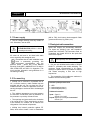
4.4.2.4 Hold
This is a gated AGC. For this reason, when the input
signal falls abruptly, the AGC does not compensate its
gain, but that congeals their current value; remaining
in that state until the signal exceeds the “hold”
threshold. Otherwise the AGC would compensate the
input level continuously, increasing the background
noise in the pauses; due to the signal absence the
AGC would increase its possible gain to the
maximum. The Gated AGC solves this disadvantage.
Strictly speaking, AGC value is not congealed; but
that slips slowly towards 0 dB; to avoid that it is
hooked if the signal remains with low level (slope =
0.75 dB each 13 seconds; 4.5 minutes from -15 dB).
On the other hand, you can adjust the HOLD
threshold to conserve part of the dynamic range of the
music. That is to say: if a "forte" passage is followed
by a subtle appearance of an instrument, the AGC will
hold its gain level, giving rise to the contrast of
loudness. When the "piano" passage reaches the
HOLD level, the AGC unhold and begins to increase
their gain according to the recovery time.
is reduced. The object of the expander is to improve
the signal/noise relation on the air. This is because the
multiband compression, although increases the
loudness, reduces relation S/R. This effect would be
annoying, but for the action of the expander.
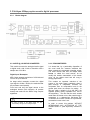
4.4.3 MULTIBAND COMPRESSOR
The object of the multiband compression is to increase
the energy in the entire audible spectrum. The
theoretical foundations of this technique are explained
in Chapter 6 of the 462dsp user's manual. Next a brief
review of multiband compression offers, and is detailed
soon how different processing adjustments affect to
music and the word.
Remember: a compressor is basically an amplifier whose gain
changes from a certain level of signal. This change of gain
denominates “compression ratio”. For example, a compressor
with a 2:1 ratio will produce an increase of 1dB at on the output
when an increase of 2dB takes place in the input. In this case
the increase of signal on the output was half with respect to the
increase on the input. The level from which the compressor
begins to be not-linear calls “compression threshold”. When the
signal surpasses the threshold, the compressor begins to
work..
On the other hand, when the signal surpasses the threshold,
the compressor takes a time in “reacting” to modify its gain.
This time is denominated “attack time”; and during the attack
the relation input/output pass to be linear to work according to
the compression ratio.
When the input signal reduces, the compressor takes in
recovering its original gain, that is to say, during a short time it
continues compressing. This time is called “recovery time”.
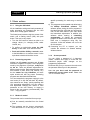
In 462dsp the compression thresholds are the same
for all the bands, to not alter the sonorous balance.
The compression degree simultaneously adjusts for
all bands, changing the level with which the signal
enters to the compressors (AGC Output). As greater
is the level, greater is the compression. You can set
the attack and recovery times for each band.
Have in mind that the settings for the compressors
and density EQ's varies according to the type of
program material, reason why there isn’t a unique
adjustment 100% optimal for all musical styles. A
great feature allows remote control from the
automation PC (using software Solidyne Audicom7)
to change the processing program according to the
music style. Remember that VirtualRack 5 also allows
defining program changes according to a scheduling.
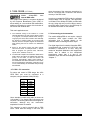
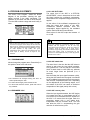
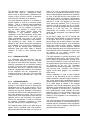
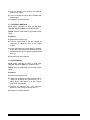
Next, a screenshot of the multiband compressor stage
and soon its description:
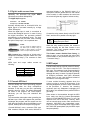
4.4.2.5 Expander threshold
Change the expander threshold; from -50 dB to -80
dB in steps of 1 dB. This level is referred to 0VU input
(overload level). The threshold is the point from which
the expander begins to reduce its gain, as signal level
SOLIDYNE 462dsp - broadcast digital processor
Page 21