1
Architecture and Performance Implications
Otherwise, the virtual machine CPU's instructions must be virtualized. This adds a varying
amount of virtualization overhead depending on the specific operation being performed. In
most cases, unprivileged, user-level application code runs in direct execution mode because, in
most operating systems, user-level code does not access privileged state data. Operating
system code does modify privileged state data and thus requires virtualization. As a result, a
micro-benchmark that makes only system calls runs significantly more slowly in a virtual
machine than on a native system. However, code that runs in direct execution mode incurs little
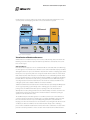
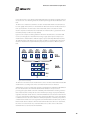
extra performance costs and runs at near-native CPU instruction speed. Figure 2 provides a
simplified view of the execution states of the VMware virtual machine monitor.
Traps, interrupts, and
system calls
Application Code
Operating System Code
Direct Execution
(near-native speed)
Virtualized Instructions
(overhead varies)
Virtual machine enters
unprivileged mode
Figure 2: Execution states of the VMware virtual machine monitor
The virtual machine runs in direct-execution whenever possible. Traps, interrupts, system calls,
and other events cause the virtual machine to enter the guest operating system, where
instructions require virtualization by the VMM.
Note that there is a distinction between emulation and virtualization. With emulation, all
operations are executed in software by an emulator. A software emulator allows programs to
run on a computer system other than the one they were originally written for. The emulator
does this by emulating, or reproducing, the original computer’s behavior by accepting the same
data or inputs and achieving the same results. With virtualization, the underlying physical
resources are used whenever possible and the virtualization layer executes instructions only as
needed to make the virtual machines operate as if they were running directly on a physical
machine.
Emulation provides portability and is often used to run software designed for one platform
across several different platforms. For example, there are a number of Atari 2600 emulators that
can run Atari 2600 games on x86-based PCs. In contrast, virtualization emphasizes performance
and runs directly on the processor whenever possible. Because VMware software virtualizes the
CPU, the virtual machine is aware of the specific model of the processor on which it is running.
Some operating systems install different kernel versions tuned for specific processor models,
and these kernels are installed in virtual machines as well. That is why it isn’t possible to migrate
virtual machines installed on a machine running one processor model (say, an AMD processor)
to another system (for example, running with Intel processors).
Performance Implications CPU virtualization adds varying amounts of overhead depending
on the percentage of the virtual machine’s workload that can run in direct execution, and the
costs of virtualizing the remaining instructions that can’t be executed directly. For applications
that are CPU-bound (that is, most of the application's time is spent executing instructions rather
than waiting for external events such as user interaction, device input, or data retrieval), any CPU
virtualization overhead likely translates into a reduction in overall performance. In those cases,
the CPU virtualization overhead requires additional instructions to be executed, which takes
CPU processing time that could otherwise have been used by the application itself. For
5