1
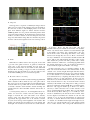
2) Length calibration: Once we know the actual location
of pixels in respect to location of Rovio, we can calculate
the distance from Rovio to start of an fake obstacle and far
end of the fake obstacle. And the difference would be the
length of an obstacle.
3) Height calibration: When identical objects were seen
in different places, the height of them in picture decreases
as the actual y-distance from Rovio increases, and was
independent from actual x-distance. If ’b’ is the actual ydistance from Rovio’s camera in centimeters and ’h’ is the
height in picture in pixel, then the relation is
actual height = h/(0.0036b2 − 0.5b + 22.613)
The data was obtained from 16 different measurements
with two obstacles of different height, and regressed into
a quadratic polynomial. The correlation R2 had very high
value of 0.99757. Error bound for test points was around
0.5cm.
This equation is effective for 26(cm) ≤ b ≤ 90(cm). If a
is less than 26, then Rovio’s camera cannot detect the bottom
of the object, and no testing was done for a larger than 90cm.
unstable IR sensor sometimes detects objects very far away.
If it detects far-away object as obstacle, it causes Rovio to
turn when there is really no obstacle in-front. Therefore,
some learning was required to learn the floor data.
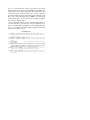
Floor learning algorithm is used to detect objects that are
too close to Rovio and fail to be captured by Edge Detection
algorithm. This problem occurs when Rovio interprets closeobjects as the ground due to the edge lying above the
trapezoid area. To avoid this problem, at every iteration,
we check whether there is any edge within trapezoid area
and also check IR sensor says false. If both conditions are
satisfied, as we did in obstacle learning, we retrieve the color
and texture of the bottom few rows of images, and store it
separately as floor data. Later, if there are no edges within
trapezoid ”safe” zone, we always check the color and texture
of the same lower part of the image from Rovio. If it is
significantly different from the floor color and texture we
stored, Rovio concludes that there is an obstacle right in front
of it, and turns around to avoid hitting it. At each iteration,
Rovio tries to retrieve the floor color as long as there are no
obstacles, so it is able to adapt to the change on floor.
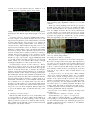
I. Trapezoid ”Safe” Area
IV. E XPERIMENT R ESULT
http://www.youtube.com/watch?v=-lqu_kAOGrg
http://www.youtube.com/watch?v=LbBWiuL9fGU
Based on obstacle learning, we know whether they are real or
fake obstacles. Whenever we are moving around, we should
not be hitting any obstacles. This trapezoid helps Rovio to
understand whether it could go forward or not. Using the
output of the SideFill algorithm, if there is any obstacle
within trapezoid we defined, we turn around. The side it
turns and the angle it turns is determined by where the
obstacle is located within the trapezoid. If there are obstacles
within region A or C, it would make small right or left turn
respectively. However, if there are obstacles within B region,
it would first whether obstacles are leaned more towards left
hand side or the right hand side, and Rovio would make
either bigger left or right turn accordingly.
J. Close-Object Detection(Floor Learning)
- a full video of Rovio on both carpet and glossy surface
part 1: Obstacle Avoidance in Robot Lab
part 2: Obstacle Learning in Robot Lab (disabled Rovio
movement for showing purposes)
part 3: Obstacle Learning in Upson Hallway
- shows it can actually distinguish between real and fake
obstacles
part 4: Navigation using SURF in CSUG Lab
part 5: Navigation + Obstacle Learning/Avoidance on
bridge between Philips and Upson
A. Experiment with Rovio movement control
The irregularity of the floor and inaccuracy of the wheel
motor makes Rovio difficult to move exactly as planned. We
experimented with Rovio’s movement under different speeds
and directions of moving and turning. In the initial phase
of this experiment, we suffered Rovio’s crude turning and
abrupt advance in case it detects an obstacle in front and
caused it to hit another obstacle. Now Rovio is more cautious
than before and does not carelessly bump into anything
around. However, we still find the problem with the turning
angle which is greatly affected by the battery level of Rovio
and is also dependent on which Rovio we use.
B. Experiment with image processing
For close-object recognition, it might seem that we could
have just used IR sensor to avoid such close obstacle.
However, through many testing, we noticed that Rovio’s very
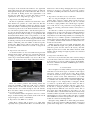
The Java Image Editor developed by the JH Labs has many
interesting filters in it, in which some are appropriate for edge
detection and some are not. We tried different combinations
of filters which works best under the decent amount of
light. Optimal result came out when we applied glow filter,
Gaussian blur filter, and edge detection in order. We have
tested under the darker room but it was detecting shadows