1
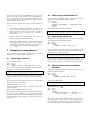
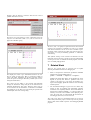
Our overall debugging system is as follows:
•
We provide a Haskell library that contains combinators for
debugging. (Taking this form allows the user to debug full
Haskell.)
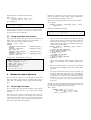
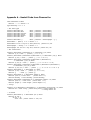
Main> tracing_sum [1,2,3]
sum [1,2,3] = 66
Main>
We have observed the behavior of sum, but needed to make nontrivial code changes to do so.
•
The frustrated Haskell programmer uses these debugging
combinators to annotate their code, and re-runs their Haskell
program.
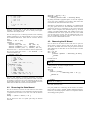
The third problem is trace changes the strictness of the things it is
observing because trace it is hyper-strict in its first argument.
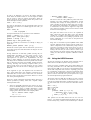
Consider a tracing version of fst.
•
The execution of the Haskell program runs as normal; there
are no behavioral changes because of the debugging annotations.
tracing_fst pair = trace message res
where
res = fst pair
message = "fst " ++ show pair ++
" = " ++ show res
•
The structures that have been marked for observation are
displayed on the users console on termination of their program.
Using this version of fst is problematic, because of the strictness
of tracing_fst.
Other versions of the debugging library allow for other debugging
setups, like offline observations of data-structures.
Main> tracing_fst (99,undefined :: Int)
fst (99,
Program error: {undefined}
Main>
2 Debugging Combinators
2.2
We introduce our new debugging combinator in terms of an improvement of the current state of the art in full Haskell debugging,
which is using an unsafe function called trace.
The function trace can be really useful for debugging Haskell, but
the bona fide shortcoming is that trace is at too low a level. Building combinator libraries is a common way to build in low-level
primitives, giving interfaces that are both friendlier and more
intuitive.
2.1 trace – A Reprise
All current Haskell implementations come with this (nonstandard) function, which has the type:
trace :: String -> a -> a
The semantics of trace is to print (as a side effect) the first argument, and return the second argument. There are three main problems with using trace for debugging.
The first problem with trace is the incomprehensibleness of output. Augustsson and Johnsson had a variation of trace in their
LML compiler [1]. Their conclusion about trace was that it was
generally difficult to understand the "mish-mash" of output from
different instances of trace. This is partly because the strictness of
the first argument of trace might itself trigger other traces, and
partly due to the unintuitive ordering of lazy evaluation. The
"mish-mash" problem could perhaps be tackled using a postprocessor on the output.
The second problem with trace is that inserting it into Haskell
code tends to be invasive, changing the structure of code, For
example, consider a variant of sum, which displays its own execution using trace.
tracing_sum xs = trace message res
where
res = sum xs
message = "sum " ++ show xs ++
" = " ++ show res
Running tracing_sum using Hugs gives:
Introducing observe
What form could a higher level debugging combinator take? Using the example in the introduction as evidence, we argue that it
should take the form of a function that allows us to observe data
structures in a transparent way. As a way of achieving this, consider the Haskell fragment:
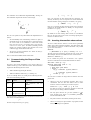
consumer . producer
Imagine if the Prelude function id remembered its argument. We
could insert strategically placed id’s, and id would tell us what got
passed from the producer to the consumer.
consumer . id . producer
We argue that a higher level combinator for debugging should
take this form, and both passing an argument transparently, and
observing and remembering it. To facilitate multiple observations
in one program, we use a string argument, which is a label used
only for identification purposes. The type of our principal debugging combinator is
observe :: (Observable a) => String -> a -> a
In the above (point-free) example, we could write:
consumer . observe "intermediate" . producer
This has identical semantics to consumer . producer, but the
observe squirrels away the data structure that gets drawn through
it, putting it into some persistent structure for later perusal. As far
as the execution of Haskell program is concerned, observe (with a
label) is just a version of id. Notice that observe can be used to
observe any expression, not just the intermediate values inside a
point-free pipeline; we will see examples of both styles later.
observe has a type class restriction on the object being observed.
This does not turn out to be as big a problem as might be thought.