1
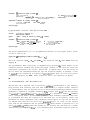
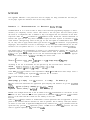
If several elements are accessed in the critical region they have to be locked simultaneously. (As is
well known such a simultaneous locking can be implemented sequentially by establishing an order
relation between the single elements. In our case “father before son” would be an obvious choice.)
This simultaneous locking even can distinguish read- and write-locks. Of course, an application of
this transformation is only reasonable if the number of elements accessed in the critical region is
..
limited.
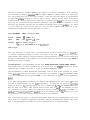
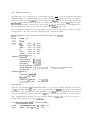
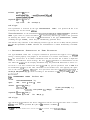
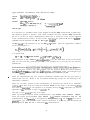
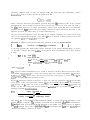
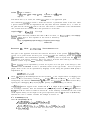
There remains one issue. The abstract data type M U L T I P L E T R E E requires that a substitution
must not take place if certain sub&es are the current trees of other processes. in a sequential
environment violation of such a requirement causes the program execution to abort. In a concurrent
environment we would rather see the process wait until some other process has resolved the
violation. (If no other process is kind enough to do this we have infinite waiting”.) The simple
solution is a re-interpretation of the undefinedness expressed in the restrictions of our data types.
We will adopt this solut,ion here for the sake of brevity although it has severe drawbacks from a
practical point of view: A process repeatedly locks and unlocks the variable in question just to see
whether the violation still exists. In this way, it continuously interferes with the other processes.
Furthermore, testing of the violation means that it has to know what the current subtrces of the
other processes are. Both problems are typical candidates for a solution by locks. Therefore we
might introduce two-new kinds of locks, one standing for “I am here” and the other standing for
“I am the only one here”. The former is compatible with both read- and write-locks, the latter
with no lock. Although this leads to the most practical solution we will not pursue the subject
here further.
3.9.
S UMMING
UP
THE
TR A N S F O R M A T I O N S
What have we gained by the lengthy considerations of this chapter?
s
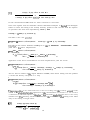
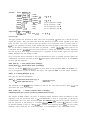
Assume that the aforementioned tools and transformations indeed are at our disposal (maybe even
aided by a mechanical system). If W C now have to develop a program that applies some fairly
complex operations to a certain tree structure -- i.e. to a rccursivc data stucturc - then all we
have to do is specify the individual tree transformations (for example, how a new leaf may be added,
how rcstructerings can bc done etc.) Since this specification is not burdened by implementation
details, it very clearly reveals the underlying algorithmic ideas.
Once this step is done, the rest of the implementation can be done almost automatically by applying
our transformation rules. The result is a program that does the desired operations in a pointer
implementation and possibly even in a concurrent environment.
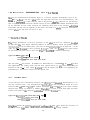
T h e rest of this paper will present an application, viz. the dcvclopment of concurrent operations
o n 2-s-trees. ‘According to the aforementioned principles it will suflicc to describe the various
individual operations as basic tree operations.
4Comparo the ongoing clisputc in the arca o f p r o g r a m m i n g l a n g u a g e s e m a n t i c s w h e t h e r i t i s a d m i s s i b l e t o identify
abortion and nontermination.
19