1
Overview of ABEL-HDL Sources
• Use intermediate signals to create multi-level logic to match FPGA
architectures.
Declaring Signals
The first step in creating a logic module for an FPGA is to declare the
signals in your design. In ABEL-HDL, you do this with pin and node
statements.
Pin
Pin Statements indicate external signals (used as inputs and
outputs to the functional block). Pin numbers are optional in
ABEL-HDL, and are not recommended for FPGAs, since pin
statements don't actually generate pins on the device package.
If you declare an external signal as a node instead of a pin, the
device fitter may interpret the signal incorrectly and delete it.
Node Node Statements indicate internal signals (not accessible by
circuitry outside the functional block). Signals declared as
nodes are expected to have a source and loads.
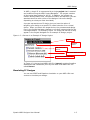
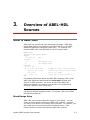
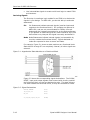
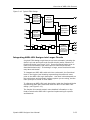
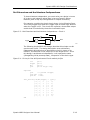
For example, Figure 3-1 shows a state machine as a functional block.
State bits S1 through S7 are completely internal; all other signals are
external.
Figure 3-1: Hypothetical State Machine as a Functional Block
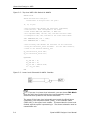
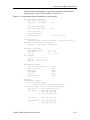
Figure 3-2 shows the corresponding signal declarations. The CLOCK,
RESET, input, and output signals must connect with circuitry outside
the functional block, so they are declared as pins. The state bits are
not used outside the functional block, so they are declared as nodes.
Figure 3-2 Signal Declarations
3-16
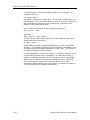
CLOCK, RESET
I0,I1,I2,I3
O1,O2
Pin;
Pin;
Pin;
S7,S6,S5,S4,S3,S2,S1
Node;
Synario ABEL Designer User Manual