1
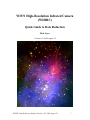
WIYN High-Resolution Infrared Camera
(WHIRC) Data Reduction Guide
1.0
Introduction
This document is a quick guide to reducing data taken with the WIYN High Resolution
Infrared Camera (WHIRC). Data reduction is a highly personal process, so one should
keep in mind the procedures described here are biased by the author’s personal
preferences and experience. Many WHIRC users may have their own (possibly superior)
means of reducing data, or use reduction platforms other than IRAF. Suggestions from
the user community will be welcomed.
As noted in the User Manual, the high and variable sky (and telescope) background in the
infrared results in background flux levels on the detector which are often far larger than
the astronomical signals which one is attempting to detect. In addition, the architecture
of infrared arrays is one of independently read out pixels, rather than the charge transfer
utilized with CCDs. Dead or “hot” pixels (with high dark current) therefore show up as
isolated features on infrared images. As with CCDs, observations of a uniformly
illuminated target (flatfields) are used to calibrate the pixel sensitivity function of the
images.
Both the high sky background and the problem of isolated dead or hot pixels are
addressed by taking multiple images of a field, moving the telescope a small distance
between integrations. This technique, referred to as “nodding” or “dithering”, results in
sampling a target at several locations on the array, so the effects of bad pixels can be
minimized. Except in very crowded fields or those with extended structure, one is also
measuring the sky level on every pixel by moving the sources around after each
individual exposure.
2.0
Data Preparation
During a night of observing, one will generally obtain the following types of
observations:
1. Flatfields: We recommend a series of dome flats in each of the filters used, at least 10
each with the lights on and an equal number with the lights off. The latter will serve as
the bias and dark subtraction. One can also generate sky flats using sky frames generated
from the observations and a series of darks of the same integration time. Sky flats may
be more used for reduction in the H and Ks filters, where there is significant thermal
background. One may also use twilight observations for sky flats in the J filter.
Nighttime observations in the narrowband filters will generally not accumulate sufficient
flux for high S/N sky flats, and even twilight flats in the narrowband filters must be
WHIRC Data Reduction Manual Version 1.03, 2009 August 24
3