1
16
The calculations stop either when the projectile has perforated the target or when it has come
to rest inside the target. If perforation occurs, the exit velocity is displayed. It may then be of
interest to find the ballistic limit, i.e. the minimum impact velocity that achieves perforation,
and the minimum target length that stops perforation. Either of these is possible, as described
later.
6.2
Multiple simulations
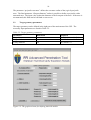
By pressing the button “Run multiple simulations”, the program performs several simulations
in order to find the relationship between impact velocity and final penetration depth. The
maximum impact velocity is the one entered in the menu system, while the minimum impact
velocity is 100 m/s. Twenty simulations are performed at constant intervals between
maximum and minimum impact velocity. This may take a few minutes depending on the
computer speed.
When the simulations are complete, a new window is opened with a plot of the relationship
between impact velocity and final penetration depth. Again, these variables (Xi and Vi) are
stored in memory.
6.3
Ballistic limit
The button “Find ballistic limit” is only relevant in the cases of finite targets. On selecting this
option, the program searches for the ballistic limit through an iteration procedure using the
following algorithm.
First the initial run is performed. If the projectile perforates the target, the initial velocity for
the next iteration is determined by the following formula:
( i )2
v0(i +1) = v0(i )2 − vrest
This comes from an empirical relationship in (6).
If the projectile does not perforate the target, the impact velocity for the next run is increased
according to this formula:
L + l (i )
v0
x (i )
where L is the target length and l is the length of the projectile nose.
v0(i +1) =
6.4
Required thickness
The button “Find required thickness” is also only relevant for finite targets. It works in the
same way as the search for ballistic limit, except that the target length (thickness) is varied in
each iteration instead of the impact velocity.