1
2
Overview
Important User Information
CompactBlock I/O for DeviceNet
Because of the variety of uses for the products described in this publication,
those responsible for the application and use of these products must satisfy
themselves that all necessary steps have been taken to assure that each
application and use meets all performance and safety requirements,
including any applicable laws, regulations, codes and standards. In no
event will Rockwell Automation be responsible or liable for indirect or
consequential damage resulting from the use or application of these
products.
Any illustrations, charts, sample programs, and layout examples shown in
this publication are intended solely for purposes of example. Since there are
many variables and requirements associated with any particular installation,
Rockwell Automation does not assume responsibility or liability (to include
intellectual property liability) for actual use based upon the examples shown
in this publication.
Allen-BradleyTM publication SGI-1.1, Safety Guidelines for the Application,
Installation and Maintenance of Solid-State Control (available from your
local Allen-Bradley office), describes some important differences between
solid-state equipment and electromechanical devices that should be taken
into consideration when applying products such as those described in this
publication.
Reproduction of the contents of this copyrighted publication, in whole or
part, without written permission of Rockwell Automation, is prohibited.
Overview
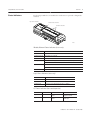
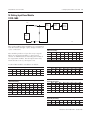
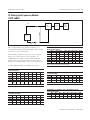
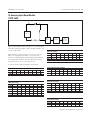
Compact Block I/O Module
CompactBlock I/O modules are compatible with PLC®, SLC™ or
SoftLogix™ programmable controllers using DeviceNet scanners. All
CompactBlock I/O module values are accessible through the data
tables of the PLC or SLC programmable controller.
Node addresses on the modules are set using rotary switches, located
on the module, RSNetworx for DeviceNet™ software or a similar
configuration tool. All other module parameters are set using a
similar configuration tool.
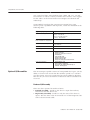
Features and Benefits
Feature:
10–30V dc device power
NEMA type 1+ inputs
output short-circuit protection
hardware watchdog function
I/O block located close to sensors and actuators
compact size of I/O block
autobaud detection
rotary node address switches
selectable input filters
change-of-state operation
ODVA conformance tested
Publication 1791D-TD001D-EP - October 2002
Benefit:
accommodates broad range of power supplies
and multiple voltage levels from the network
compatible with a broad range of sensors
protects outputs against accidental miswiring
puts outputs in a known state if the
microprocessor or crystal fails
lower wiring costs
module requires no adapter or power supply
module automatically matches system baud
rate - no crashing due to incorrect baud
setting
reduces node commissioning time
select off-to-on and on-to-off delays best
suited for your application
improves network throughput by reducing
network bandwidth usage
assures interoperability with other DeviceNet
compliant devices and systems