1
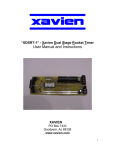
Congratulations on the purchase of your new staging/ejection
timer. Please read these instructions carefully before attempting to
use the timer to insure safe and successful operation.
These timers can be used in a number of applications:
o Ignition of upper stages in multi-stage rockets.
The first stage (booster) motor is ignited conventionally on the
pad. The timer is triggered as the rocket rises, beginning its
timing cycle. After the user-programmed interval (coincident
with booster motor burnout), power is applied to the next
stage’s ignition system. Electronic ignition of the upper stage
allows for staging of composite propellant motors and the use
of longer booster sections which are not generally suitable for
conventional “burn-through” (gap) staging techniques.
o
Airstart ignition of auxillary motors in clustered rockets.
The main motor is ignited conventionally on the pad, and the
timer is triggered as the rocket lifts off. After the programmed
time interval additional motors in the cluster are ignited by the
timer, providing an extended burn time for greater altitude.
o
Electronic deployment of recovery devices.
The timer is activated at liftoff. After the programmed time
interval power is provided to an ejection charge to deploy the
parachute. The timer provides a wider range of precise,
repeatable delay times than that which is available with the
motor’s built-in delay. Keeping an assortment of motors with
different delay times is no longer necessary. Since the motor
ejection charge is not used, the problem of delay “blow-by”
causing premature ejection is eliminated.
o
Redundant deployment of recovery devices.
An altimeter or accelerometer provides the primary recovery
system deployment, and the timer ignites an additional
ejection charge several seconds “late” as a backup in case of
altimeter/accelerometer failure.