1
PCI-12AIO
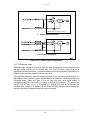
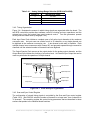
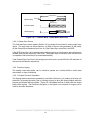
Output Data Buffer
End Burst Flag
a. Function Loaded
Circulating Data
b. Clock enabled;
Function Recirculating
To DAC’s
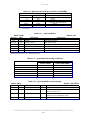
Figure 3.6-2. Periodic Function; Output Buffer Data Flow
3.6.5.2 One-Shot Functions
If the End Burst flag in the output buffer is set HIGH at the end of a periodic function, the
function operates as described for a data burst, but is not be discarded as it would be if the
buffer were open, or non-looping. In this configuration, a burst function in the closed output
data buffer can be initiated repeatedly by successive sync inputs.
3.6.5.3 Multiple Burst Queue
By loading a group of burst functions into the output data buffer, the functions can be queued to
generate a sequence of discrete bursts. Each burst is terminated by a Burst End flag, and each
sync input initiates the next burst in the queue. The sequence can be repeated indefinitely, and
the number of functions that can be queued in this manner is limited only by the 32K-sample
capacity of the buffer.
3.7 Autocalibration
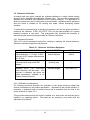
To obtain maximum accuracy from the PMC-12AIO board, autocalibration should be performed
after power warmup and after each initialization. Autocalibration uses current settings for the
analog input/output voltage range, and ignores all other control parameters such as input
configuration, clocking rates, etc. No control settings are altered during autocalibration, and
existing analog input signals are ignored.
Autocalibration is invoked by setting the Autocal control bit HIGH in the BCR. The control bit
returns LOW (normal operation) automatically at the end of autocalibration. Autocalibration can
be invoked at any time, and has a duration of approximately 2 seconds. Completion of the
operation can be detected either by polling the Autocal control bit in the BCR for a LOW (zero)
state, or by selecting the 'Autocalibration Operation Completed' interrupt condition (paragraph
3.9) and waiting for the interrupt request.
Note: The analog outputs are active during autocalibration.
To compensate for component aging, and to minimize the effects of temperature on accuracy,
the autocalibration function determines the optimum calibration values for current conditions,
and stores the necessary correction values in calibration DAC's. If a board is defective, the
autocalibration process may be unable to successfully calibrate all channels. If this situation
occurs, the AUTOCAL PASS status bit in the BCR will be cleared LOW at the end of the
__________________________________________________________________________________________
General Standards Corporation Ph:(256)880-8787 FAX:(256)880-8788 Email: solutions@GeneralStandards.com
3-15