1
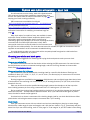
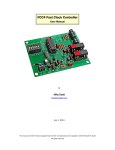
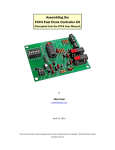
APPENDIX H – EVOLUTION OF THE FCC4 History I have offered fast clock controllers, culminating with the FCC3, since 1997, when my article appeared in the August 1997 Model Railroader. There have been minor improvements, but the FCC3 always gave excellent performance with the Quartex Q80 clock movement sold by Klockit. End of the line? Initially, all Q80 movements were manufactured in the USA. But around 2009, Quartex began importing Q80 movements from China, and I experimented to see if these would work with the FCC3. The test was a dismal failure – no amount of tweaking or programming changes would coerce them to run at high speed. Fortunately, Klockit still had some USA-made Q80 movements, and sold these "premium" movements at a higher price, so the FCC3 enjoyed an extended life. But all good things must end, and eventually Klockit's supply of premium movements ran out, and so did my stock. Quartex told Klockit all future Q80s would be imported – suitable fast-clock movements were no longer available. Without a source of clock movements, the FCC3 was doomed. Birth of the FCC4 In 2013 I decided to experiment again with the imported Q80 movements. Happily, it appears that the design changed since 2009, and making the movements operate at high speed turned out to be straightforward (after several months of experimenting and testing). Major changes were needed. I completely redesigned the FCC3, turning it into the FCC4. I focused especially on the "clock driver" section, because this was key to make the imported Q80s work. The clock driver components cost significantly more than those on the FCC3, but the results are notable. The FCC4 can power up to 15 clocks using imported Q80s, compared to The FCC3's 10 clocks with USA-made Q80s. In addition to the redesigned hardware, I rewrote the firmware (software code programmed into the microprocessor chip) and added several new features to the FCC4: 16 clock speeds vs. 15 for the FCC3. 16 additional "fractional" clock speeds from 2½:1 to 7¾:1. LEDs on the circuit board aid in verifying proper operation. Fewer control switches. The FCC3's seldom-used 1:1/Fast Time and 1-Hour/12-Hour Reset control switches are gone. These originally were intended for demonstration purposes, but few, if any, modelers used them. Their presence only confused the testing and installation instructions. Relaxed power supply requirements. The FCC4 needs a power supply delivering between 8VDC and 10VDC, compared to the FCC3's 11VDC, with little variance. The FCC3's stringent requirements were due to how the movements were modified, and the need to feed them a very narrow range of voltages. The FCC4 eliminates this restriction, and greatly expands the choice of suitable power supplies. FCC4 Fast Clock Controller User Manual Page 61