1
 Lesson: 13/19
Safety Barriers
While safety devices protect workers by interrupting a robot's operating cycle, safety
barriers simply prevent workers from entering dangerous areas. A safety barrier can
take the form of a gate or a fence. Gates are moveable barriers that prevent access to
dangerous areas during the robot's cycle. An alternative to a gate is a perimeter
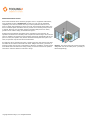
fence placed outside the work area of the robot. Perimeter fences are permanent
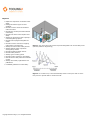
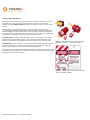
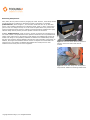
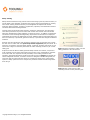
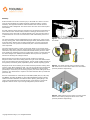
barriers that prevent nearby workers from entering a hazardous space, as shown in
Figure 1. If you must enter a barrier, always use the teach pendant to prevent
accidental activation of the robot.
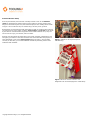
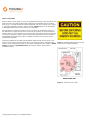
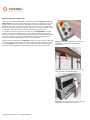
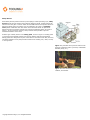
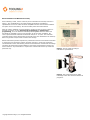
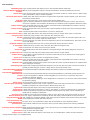
Another type of safety barrier is the safety guard, shown in Figure 2. A safety guard
is a rigid cover that shields workers from moving machine parts and flying debris.
Safety guards are designed to be part of the robot or the robot's work area, and they
should be installed in a way that prevents workers from reaching over, under, around,
or through them.
Figure 1. A perimeter fence prevents workers from
entering a hazardous space. [Courtesy of Kawasaki
Robotics (USA), Inc.]
Figure 2. Guards should be secure, tamper
resistant, and durable.
Lesson: 14/19
The Four Types of Safety Guards
There are four types of safety guards. A fixed guard is an immovable barrier that
allows operators to feed parts through while keeping dangerous areas out of reach.
Fixed guards can be made of different materials such as metal, wire, plastic, or cloth.
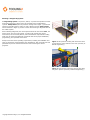
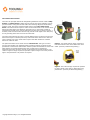
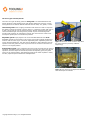
Interlocked guards have a tripping mechanism that causes the robot to stop when
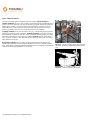
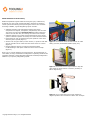
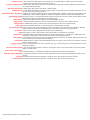
the guard is moved. An interlock, shown in Figure 1, is generally a switch that goes on
a door or hinge and can only be opened with a key. With an interlocked guard, the
robot cannot start again until the guard is put back in place. Interlocked guards
provide good protection to maintenance workers who must enter the robot's work
envelope to replace parts or troubleshoot problems.
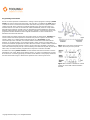
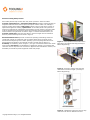
Adjustable guards simply adjust in size to accommodate different sized stock.
Adjustable guards are convenient to use but may not provide complete protection to
Copyrightnear
© 2009
LLC. All
Rights Reserved.
workers
theTooling
robot.U,Figure
2 shows
an adjustable guard. Adjustable guards can
require frequent adjustment. They also may be defeated or made ineffective when an
operator moves the guard out of the way for the sake of convenience and does not
Figure 1. Interlocks cause a robot to stop when
the gate is opened. (Courtesy of Banner