1
avr-libc: <avr/interrupt.h>: Interrupts
10/19/09 11:32 AM
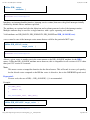
}
Refer to the chapter explaining assembler programming for an explanation about interrupt routines written
solely in assembler language.
Catch-all interrupt vector
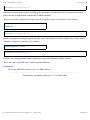
If an unexpected interrupt occurs (interrupt is enabled and no handler is installed, which usually indicates a
bug), then the default action is to reset the device by jumping to the reset vector. You can override this by
supplying a function named BADISR_vect which should be defined with ISR() as such. (The name
BADISR_vect is actually an alias for __vector_default. The latter must be used inside assembly code in
case <avr/interrupt.h> is not included.)
#include <avr/interrupt.h>
ISR(BADISR_vect)
{
// user code here
}
Nested interrupts
The AVR hardware clears the global interrupt flag in SREG before entering an interrupt vector. Thus,
normally interrupts will remain disabled inside the handler until the handler exits, where the RETI
instruction (that is emitted by the compiler as part of the normal function epilogue for an interrupt handler)
will eventually re-enable further interrupts. For that reason, interrupt handlers normally do not nest. For
most interrupt handlers, this is the desired behaviour, for some it is even required in order to prevent
infinitely recursive interrupts (like UART interrupts, or level-triggered external interrupts). In rare
circumstances though it might be desired to re-enable the global interrupt flag as early as possible in the
interrupt handler, in order to not defer any other interrupt more than absolutely needed. This could be done
using an sei() instruction right at the beginning of the interrupt handler, but this still leaves few instructions
inside the compiler-generated function prologue to run with global interrupts disabled. The compiler can be
instructed to insert an SEI instruction right at the beginning of an interrupt handler by declaring the handler
the following way:
ISR(XXX_vect, ISR_NOBLOCK)
{
...
}
where XXX_vect is the name of a valid interrupt vector for the MCU type in question, as explained below.
Two vectors sharing the same code
In some circumstances, the actions to be taken upon two different interrupts might be completely identical
http://www.nongnu.org/avr-libc/user-manual/group__avr__interrupts.html
Page 2 of 50