1
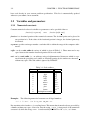
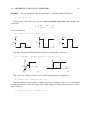
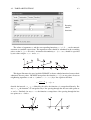
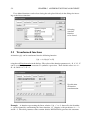
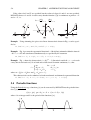
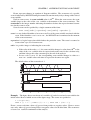
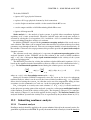
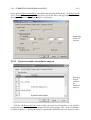
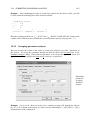
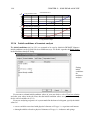
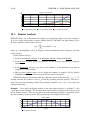
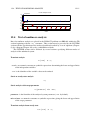
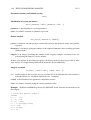
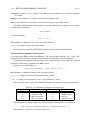
5.3. TRIMMED FUNCTIONS 5-3 FL /LIN/ A = -2, B = 3; The equations v = 3t − 2 and Q = 3p − 2, for example, can be submitted as v = FL(time); Q = FL(p); Example. The function f (•) = I0 (eθ • − 1) denoted as D1 can be formed by transforming the standard function exp(•) with the parameters A = −I0 , B = I0 ,C = theta. This would result in the statement D1 /EXP/ A = -I0, B = I0, C = theta; This function can be then used, for example, in the equations i1 = D1(v1); i2 = D1(v2); Example. £ ¤2 The equation q = −4 + 3 (2p − 1) + 5(2p − 1)3 can be submitted as F /POLY/ 0, 1, 0, 5, A = -4, B = 3, C = 2, D = -1, E = 2; q = F(p); where the first statement was generated by DYNAST for a transformed user-defined polynomial function specified by its coefficients. 5.3 Trimmed functions Specification of function trimming. Using the Trimming tab in the dialogs a function g(•) can be trimmed to form the function f (•) linearly extrapolated outside the interval L < x < U in such a way that •<L g(L) + SL (• − L) g(•) L ≤•≤U f (x) = (5.1) g(U) + SU (• −U) for • > U While L and U are limits of the trimming interval, SL and SU are slopes of the linear extrapolations outside this interval. Values of parameters L, U, SL and SU can be specified as numeric constants or symbolic expressions. The default values of L and U are L = −∞ and U = ∞.