1
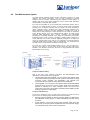
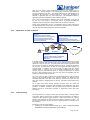
Potential applications within an IP Service Provider Network for the M-xxx are
explained below.
1.4.1
Backbone Routing
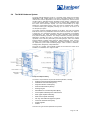
Juniper proposes using the M-xxx Internet backbone routers for interconnecting
the different sites in an IP Service Provider Network.
The advantage of using a high-speed backbone router for this purpose is that you
can use either E3/DS3 interfaces, ATM interfaces, which scale up to OC12
speeds today or Packet over SONET (POS) interfaces, which scale up to OC48.
Key features which make the M-xxx ideal for this role include:
Routing
§
Robust BGP4 implementation with confederations, route reflectors,
communities, route flap damping, TCP MD5 authentication and Multiprotocol
BGP. Junos can handle and scale for multiple EBGP and IBGP peering.
§
Highly scalable OSPF, IS-IS interior gateway protocols.
§
Flexible policy software for filtering and modifying route advertisements.
§
M-xxx is very responsive to routing fluctuation, remains stable even in the
face of massive routing churn, and experiences no impact on the forwarding
performance.
Port Density
§
M-xxx can support multiple interface types each in a very dense
configuration. This can offer considerable cost per port savings advantages.
All the interfaces can forward traffic at wire rate for any packet size and under
extremely unstable network conditions.
1.4.2
Peering
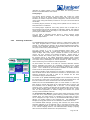
The M-xxx can also serve as an ideal peering router because of its robust,
feature-rich and interoperable BGP4 implementation and a flexible and powerful
routing policy software.
In many networks today, peering is done on an “edge” router. The M-xxx can
either serve this function by replacing the existing peering routers or you can do
peering on the core backbone routers.
For the connectivity to the different peers (ISPs), there is a wide range of options
that scale from DS3 to OC48 Sonet/SDH, each one offering high port density.
Multiple Juniper customers for the use on their own network have certified both
peering and backbone routing as ideal applications for the M-xxx.
1.4.3
Traffic Management via MPLS
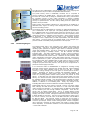
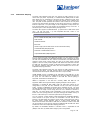
Juniper Networks believes that Multiprotocol Label Switching (MPLS) is the
emerging solution to support traffic engineering in large service provider
networks.
It combines the advantages of router-based and ATM-based cores, while
eliminating the disadvantages. Juniper is able o
t fully support Service Providers’
plans to migrate to an MPLS based core backbone, from either an pure IP core or
a mixed IP / ATM core.
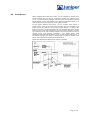
MPLS as a technology enables a services provider to :
1.5
§
Better engineer its own backbone to enforce quality of service, control the
traffic evolution and optimize costs,
§
Better serve its customers’ base with appropriate SLA’s, differentiated
qualities of service and new emerging services such as VPNs.
Active participation in standards bodies
Juniper is a member of the Optical Internetworking Forum. Juniper is also active
in the IETF (Internet Engineering Task Force), where Juniper employees have
contributed to a great number of RFC’s. Juniper is also active with organizations
such as NANOG (North American Network Operators Group), RIPE, APRICOT
and the MPLS Forum.
Page 9 /148