1
DSP
PREFACE
PRESETS
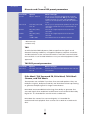
Music and Trifield DSP preset parameters
Parameter
Options
What it changes
Centre
Flat, EQ1–3
The timbre of the centre loudspeaker.
Width†
0–1.5
The width of the image.
Surr. Rear
Surr. Rear, Surr. Side, Surr.
All
Switches the surround signal between the
side and rear speakers.
R Filter
Off, 1kHz, 3kHz, 7kHz
The cutoff of high frequencies from the
rear surrounds.
S Filter
Off, 1kHz, 3kHz, 7kHz
The cutoff of high frequencies from the
side surrounds.
† Trifield only.
Ambisonics
The Ambisonics DSP preset can decode two-channel UHJ format, the stereocompatible surround encoding found on Ambisonically-recorded discs and
broadcasts. This material is specifically encoded for surround reproduction
and can give breathtakingly realistic sound when replayed using the digital
surround controller.
Ambisonic surround sound is quite unlike conventional stereo. A special
microphone can be used to capture the sound of the original performance
in all three dimensions, allowing a recording to be made in a special format
(B-Format) that describes the soundfield exactly at the microphone
position. Alternatively, special mixing techniques including Ambisonic
spatial localisation controls (panpots) can be used to mix conventional
multitrack into the same Ambisonic surround format. The channels of this
recording can then be encoded using a phase-amplitude matrix (UHJ) to
allow the surround information to be conveyed, typically via a two-channel
medium such as disc or FM broadcast. On playback, the decoder
reconstructs the soundfield captured by the original recording.
The digital surround controller uses accurately matched, frequencydependent, phase-amplitude matrices to decode the signal and construct
the signals for each speaker feed.
The fundamental difference between Ambisonics surround sound and
conventional stereo is that the signals from all the speakers combine to
produce a coherent soundfield at the listening position, giving the illusion
that you are sitting inside the recording space whether you are at the exact
central seat or well off to one side.
Of all the signal-processing options, Ambisonics is the one that requires the
greatest attention to speaker choice and positioning.
37