1
Introduction
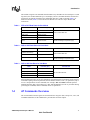
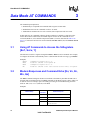
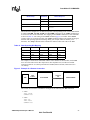
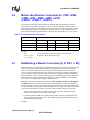
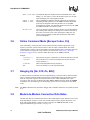
The modem recognizes AT commands from the DTE at any valid data rate from 300 bps to 115,200
bps (that is, the modem autobauds up to 115,200 bps); however, the DTE should use the data rate
specified for each mode according to the transmitting direction—DTE-to-modem (Table 1) or
modem-to-modem (Table 2). The V.90 and V.92 data rates are effective only in DCE-to-ISP
connections.
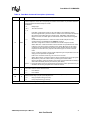
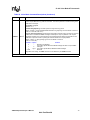
Table 1.
DTE-to-DCE Data Rates for Each Mode
Mode
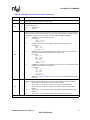
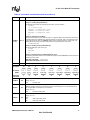
Table 2.
Data (V.34)
2400–115,200
Data (V.90)
28,800–115,200
Data (V.92)
28,800–115,200
Fax
19,200
Voice
19,200–115,200
Affected Data
DTE-to-modem data rate
AT commands, playback and record modes
(varies according to compression type)
DCE-to-DCE Data Rates for Each Mode
Mode
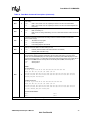
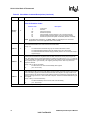
Table 3.
Data Rate (bps)
Data Rate (bps)
Data (V.34)
(transmit and receive)
2400–33,600
Fax
300–14,400
Voice
19,200–115,200
Affected Data
DTE-to-modem data rate
AT commands, playback and record modes
(varies according to compression type)
DCE-to-ISP Data Rates for V.90 Mode
Mode
Data Rate (bps)
Data (V.90) transmit
4800–33,600
Data (V.90) receive
28,000–56,000
Data (V.92) transmit
24,000–48,000
Data (V.92) receive
28,000–56,000
Affected Data
ISP-to-modem data rate
Each command may have one or more parameters associated with it. If a parameter is not sent for a
command requiring a numeric parameter, then the modem assumes a zero (‘0’) parameter (only if
zero is a valid parameter for the command). For example, ATZ and ATZ0 commands perform
identical functions (that is, the modem sees ‘ATZ’ and automatically uses the ‘0’ parameter during
processing the command). Other commands do not use parameters.
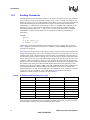
1.4
AT Commands Overview
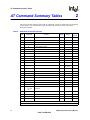
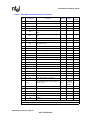
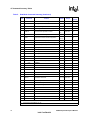
The AT command set and S-registers are divided into four categories: data, Group 3 fax, voice, and
V.42/MNP. Summaries of all commands are provided later on in this chapter.
536EX Chipset Developer’s Manual
11
Intel Confidential