1
General safety information
1.3 Conformity
2 General safety information
The refrigerant circuit is tested for leakage. The appliance
complies with the relevant safety regulations and EC Directives
2006/95/EC, 2004/108/EC, 2009/125/EC and 2010/30/EU.
Danger for the user:
- This appliance is not designed for persons (including children) with physical, sensory or mental impairment or
persons not having sufficient experience and knowledge,
unless they are instructed in the use of the appliance and
are initially supervised by a person responsible for their
safety. Keep children under supervision to ensure they do
not play with the appliance.
- When disconnecting the appliance from the supply, always
take hold of the plug. Do not pull the cable.
- In the event of a fault pull out the mains plug or deactivate
the fuse.
- Do not damage the mains power cable. Do not operate the
appliance with a defective mains power cable.
- Have any repairs to or intervention in the appliance, and any
change of the mains power cable, carried out by the
customer service only or by other specialised personnel
trained for the purpose.
- Install and connect the appliance only as instructed.
- Please keep these instructions in a safe place and pass
them on to any subsequent owners.
Fire hazard:
- The refrigerant R 600a is environmentally friendly but flammable. Escaping refrigerant may ignite.
• Do not damage the refrigerant circuit pipes.
• Do not allow naked flames or ignition sources to enter the
appliance.
• Do not use any electrical appliances in the interior (e.g.
steam cleaners, heaters, ice cream maker etc.).
• If refrigerant escapes: remove any naked flames or
sources of ignition from the leakage area. Ventilate the
room well. Notify the after-sales service.
- Do not store explosives or sprays using combustible propellants such as butane, propane, pentane, etc. in the appliance. To identify these spray cans, look for the list of
contents printed on the can, or a flame symbol. Gases
possibly escaping may ignite due to electrical components.
- Keep burning candles, lamps and other items with naked
flames away from the appliance so that they do not set the
appliance on fire.
- Always store high-percentage alcohol in tightly sealed,
upright containers. Alcohol possibly escaping may ignite
due to electrical components.
Danger of tipping and falling:
- Do not misuse the plinth, drawers, doors etc. as a step or for
support. This applies particularly to children.
Danger of food poisoning:
- Do not consume food which has been stored too long.
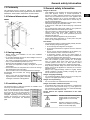
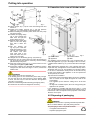
1.4 External dimensions of the appliance
Fig. 2
1.5 Saving energy
- Always ensure good ventilation. Do not cover ventilation
openings or grille.
- Do not place appliance in areas of direct sunlight or next to a
stove, heater or similar object.
- The energy consumption depends on the installation conditions, e.g. the ambient temperature (see 1.2) .
- Keep the time the appliance is open to a minimum.
- The lower the temperature setting, the higher the power
consumption.
- Ensure that all food is well packed and covered for storage.
This will prevent frost from forming.
- First cool warm food to room temperature before storing it .
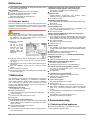
Accumulated dust increases the energy
consumption:
- Once a year, dust the refrigerating unit
together with the metal grille of the heat
exchanger at the back of the appliance.
1.6 Insulation plate
The insulation plate for part-load operation is available as an
accessory from specialist dealers.
If you do not store much food in the appliance, you can reduce the power consumption by as much as 50 % by using the insulation plate. Up to 5 drawers can be deenergised, depending on model. At least 3
drawers are necessary for cooling. More
information accompanies the insulation
plate.
Danger of frostbite, numbness and pain:
- Avoid lasting skin contact with cold surfaces or refrigerated/
frozen food or take protective steps, e.g. wear gloves. Do
not consume ice cream, water ice or ice cubes immediately
and do not consume them too cold.
Please observe the specific information in the other
sections:
DANGER
identifies a situation involving direct
danger which, if not obviated, may
result in death or severe bodily
injury.
WARNING
identifies a dangerous situation
which, if not obviated, may result in
death or severe bodily injury.
3