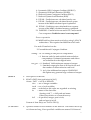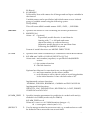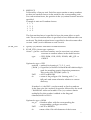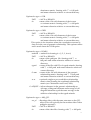
1
random factor number followed by row-column (trait) combination and finally the prior
(co)variance.
Optional input for DMUAI
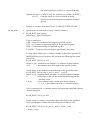
DMUAI can read an optional file containing parameters to control the maximization
process. The format is five lines with one parameter per line in the sequence shown in the
table below. The values shown are the default values.
Value
10
1.0d-7
1.0d-6
1
0
Name
EMSTEP
CONV_NDELTA
CONV_GNORM
PRINTOUT
FSPOPT
Description
Number of steps before full weight on EM in IMET = 1
Convergence criteria for norm of the update vector
Convergence criteria for norm of the gradient vector (AI)
Solution vector is printed/written to file SOL
Use of time (0) or memory (1) optimized parts of FSPAK
to calculate the sparse inverse of the coefficient matrix of
the mixed model equations.
Optional input for DMU4
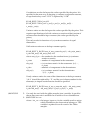
DMU4 can compute standard error of selected solutions. This is particularly useful when
using one of the iterative solvers, because such procedures do not yield standard errors of
the solutions because this requires the inverse of the coefficient matrix for the mixed
model equations. It is, however, possible to obtain selected elements of this inverse using
the same iterative process.
It is therefore possible to specify up to 100 equations where the standard error of the
solution is desired. DMU4 will print a table with the selected solutions and their standard
errors, and another table with correlations among all solutions. Based on this, various
hypotheses can be tested.
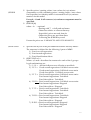
The selected solutions can be specified in the driver file on lines following the $DMU4
keyword line, or in a file pointed to by the fn option in the $DMU4 keyword line. The
format is one equation number per line, and a max. of 100 lines is possible.
Optional input for DMU5
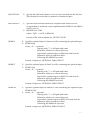
DMU5 can read optional input consisting of up two lines.
The first line controls the iteration process by specification of maximum number of
iterations and convergence criteria.
20