1
diagonal matrix D. Colon notation is used for submatrices. For example, Lk,1:k−1 refers
to the first k − 1 columns of the kth row of L. Similarly, L1:k−1,1:k−1 refers to the leading
(k − 1)-by-(k − 1) submatrix of L.
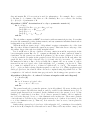
Algorithm 1 (LDLT factorization of a n-by-n symmetric matrix A)
for k = 1 to n
(step 1) Solve L1:k−1,1:k−1 y = A1:k−1,k for y
T
(step 2) Lk,1:k−1 = (D−1
1:k−1,1:k−1 y)
(step 3) lkk = 1
(step 4) dkk = akk − Lk,1:k−1 y
end for
The algorithm computes an LDLT factorization without numerical pivoting. It can thus
factorize any symmetric positive definite matrix, and any symmetric indefinite matrix whose
leading minors are all well-conditioned.
When A and L are sparse, step 1 of Algorithm 1 requires a triangular solve of the form
Lx = b, where all three terms in the equation are sparse. This is the most costly step of the
Algorithm. Steps 2 through 4 are fairly straightforward.
Let X and B refer to the set of indices of nonzero entries in x and b, respectively, in the
lower triangular system Lx = b. To compute x efficiently the nonzero pattern X must be
found first. In the general case when L is arbitrary [8], the nonzero pattern X is the set
of nodes reachable via paths in the graph GL from all nodes in the set B, and where the
graph GL has n nodes and a directed edge (j, i) if and only if lij is nonzero. To compute
the numerical solution to Lx = b by accessing the columns of L one at a time, X can be
traversed in any topological order of the subgraph of GL consisting of nodes in X . That
is, xj must be computed before xi if there is a path from j to i in GL . The natural order
(1, 2, . . . , n) is one such ordering, but that requires a costly sort of X . With a graph traversal
and topological sort, the solution of Lx = b can be computed using Algorithm 2 below. The
computation of X and x both take time proportional to the floating-point operation count.
Algorithm 2 (Solve Lx = b, where L is lower triangular with unit diagonal)
X = ReachGL (B)
x=b
for i ∈ X in any topological order
xi+1:n = xi+1:n − Li+1:n,i xi
end for
The general result also governs the pattern of y in Algorithm 1. However, in this case L
arises from a sparse Cholesky factorization, and is governed by the elimination tree [10]. A
general graph traversal is not required. In the elimination tree, the parent of node i is the
smallest j > i such that lji is nonzero. Node i has no parent if column i of L is completely
zero below the diagonal; i is a root of the elimination tree in this case. The nonzero pattern
of x is the union of all the nodes on the paths from any node i (where bi is nonzero) to the
root of the elimination tree [9, Thm 2.4]. It is referred to here as a tree, but in general it
can be a forest.
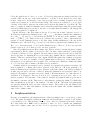
Rather than a general topological sort of the subgraph of GL consisting nodes reachable
from nodes in B, a simpler tree traversal can be used. First, select any nonzero entry bi and
2