1
•
Has a large amount of ice just been removed? Allow
24 hours for ice maker to produce more ice.
•
Is the control set correctly? If too little ice is produced, see
"Using the Control(s)," depending on the model.
•
Is a reverse osmosis water filtration system connected to
your cold water supply? See "Water Supply Requirements."
NOTE: If not due to any of the above, there may be a problem
with the water line. Call for service.
Off-taste
•
Are the door(s) opened often? To avoid humidity buildup,
try to get everything you need out of the refrigerator at once,
keep food organized so it is easy to find, and close the door
as soon as the food is removed. When the door is opened,
humidity from the room air enters the refrigerator. The more
often the door is opened, the faster humidity builds up,
especially when the room itself is very humid.
•
Is the room humid? It is normal for moisture to build up
inside the refrigerator when the room air is humid.
•
Is the food packaged correctly? Check that all food is
securely wrapped. Wipe oft damp food containers before
placing in the refrigerator.
•
Are the controls set correctly for the surrounding
conditions?
See "Using the Control(s)," depending on the
model.
or gray color in the ice
•
Are the plumbing connections new, causing discolored or
off-flavored ice? Discard the first few batches of ice.
•
Have the ice cubes been stored for too long? Throw away
old ice and make a new supply.
•
Has food in the refrigerator
"Refrigerator Features."
•
Do the freezer
"Cleaning."
•
Does the water contain minerals (such as sulfur)? A filter
may need to be installed to remove the minerals.
been wrapped
Was a self-defrost cycle completed? It is normal for
droplets to form on the back wall after the refrigerator selfdefrosts.
properly? See
and ice bin need to be cleaned?
See
The doors are difficult to open
The divider between the two compartments is warm
The warmth is probably due to normal operation of the automatic
exterior moisture control. If still concerned, call for service.
Temperature
•
is too warm
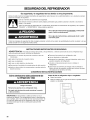
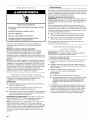
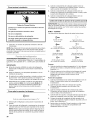
Explosion
Are the air vents blocked in either compartment? This
obstructs cold air movement between the compartments.
Remove any objects from in front of the air vents. See
"Ensuring Proper Air Circulation" for the location of air vents.
•
Are the door(s) opened often? Be aware that the refrigerator
will warm when this occurs. In order to keep the refrigerator
cool, try to get everything you need out of the refrigerator at
once, keep food organized so it is easy to find, and close the
door as soon as the food is removed.
•
Has a large amount of food just been added to the
refrigerator or freezer? Adding a large amount of food
warms the refrigerator. It can take several hours for the
refrigerator to return to the normal temperature.
•
Are the controls set correctly for the surrounding
conditions? See "Using the Control(s)," depending
model.
There is interior
•
18
moisture
on the
Use nonflammable
cleaner.
Failure to do so can result in death, explosion,
•
or fire.
Are the gaskets dirty or sticky? Clean gaskets and the
surface that they touch. Rub a thin coat of paraffin wax on the
gaskets following cleaning.
The doors will not close completely
•
Are food packages blocking the door open? Rearrange
containers so that they fit more tightly and take up less
space.
•
Is the ice bin out of position?
•
Are the crisper cover, pans, shelves, bins, or baskets out
of position? Put the crisper cover and all pans, shelves, bins,
and baskets back into their correct positions. See
"Refrigerator Features."
•
Are the gaskets sticking? Clean gaskets and the surface
that they touch. Rub a thin coat of paraffin wax on the
gaskets following cleaning.
•
Does the refrigerator wobble or seem unstable?
refrigerator. See "Adjust the Doors."
•
Were the doors removed during product installation and
not properly replaced? Remove and replace the doors
according to "Refrigerator Doors," or call a qualified service
technician.
buildup
Are the air vents blocked in the refrigerator? Remove any
objects from in front of the air vents. See "Ensuring Proper Air
Circulation" for the location of air vents.
Hazard
Push the ice bin in all the way.
Level the