1
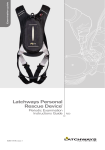
Personal Rescue Device
User Instruction Manual
5. System requirements
5.1 Risk assessment and rescue planning
CA
Figure 2
The PRD forms part of a fall protection system and as such it is recommended
that before undertaking work at height and at regular intervals during the
period of work, a risk assessment should be carried out. The risk assessment
should cover, but is not limited to, descent height, descent path, suitability of
landing areas.
The risk assessment should take into account clearance below the working
platform. Note that stretch in the harness supplied as part of the PRD may
contribute an additional 1.6 feet (500 mm) to the distance the wearer will fall below the working platform.
In addition to the risk assessment ensure a rescue plan is in place to deal with any emergency that may
arise and you are fully aware of the procedure before attempting to work at height.
The PRD is designed primarily as a self-rescue system and will assist with rescue planning. However, in the
event that the user is unable to initiate self-rescue a secondary release means is provided on the right-hand
shoulder area. This takes the form of a red and black rubberized loop which can be pulled by a rescuer to
activate the descent (See Figure 2). Secondary release by a rescuer should be taken into account in the
risk assessment.
5.2 Unprotected edges
It is good working practice to avoid allowing any parts of a fall arrest system (including the harness and
lanyard) from contacting, or abrading against, unprotected edges.
✔
The risk assessment described in Section 5.1 should identify appropriate precautions to be taken to avoid
contact with unprotected edges or where use over an edge is possible, the risk assessment should identify
appropriate precautions to be taken.
5.3 Connected elements
100%
5.3.1 Anchor
Only use the PRD with a suitable fall protection system (complying with appropriate ANSI, CSA or OSHA
requirements), connected back to a suitable anchorage connector and structure. Anchorage connectors
100%
and
structure must be able to sustain a minimum load of 5,000 pounds (22.5 kN) (refer to CSA Z259.13,
CSA Z259.15, ANSI Z359.1 & OSHA regulations). If more than one user is attached to the same anchor
then the anchor should be capable of sustaining the loads arising from multiple falls. Before connecting to
the anchor, consideration should be given to the descent path, refer to Section 7.3.
6
300
kg
WARNING! It is essential for safety that the anchor device or anchor point
should always be positioned and work carried out, in such a way as to minimize
both the potential for falls and potential fall distance. It is also recommended
that the anchor device/point is positioned above the position of the user.
5.3.2 Lanyard
Always use an energy absorbing lanyard or retractable type fall arrestor that comply with relevant standards
such as CSA Z259.2.2, CSA Z259.11, ANSI Z359.1 or ANSI Z359.13.
5.3.3 Connectors
Connectors must conform to CAN / CSA Z259.12, ANSI Z359.1 or ANSI Z359.12 and be securely locked
to prevent opening.
11