1
CUTMASTER 152
4T.05Gouging
!
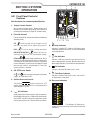
Current Setting
Current settings depend on torch travel speed, mode of
operation (hand or machine torch), and the amount of
material to be removed.
WARNING
Pressure Setting
Be sure the operator is equipped with proper
gloves, clothing, eye and ear protection and
that all safety precautions at the front of this
manual have been followed. Make sure no
part of the operator’s body comes in contact with the workpiece when the torch is
activated.
Disconnect primary power to the system before disassembling the torch, leads, or power
supply.
Even though the setting is within the specified range, if
the torch does not pilot well the pressure may need to be
reduced.
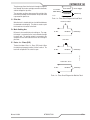
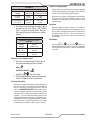
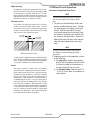
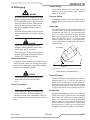
Lead Angle
The angle between the torch and workpiece depends on
the output current setting and torch travel speed. The
recommended lead angle is 35°. At a lead angle greater
than 45° the molten metal will not be blown out of the
gouge and may be blown back onto the torch. If the lead
angle is too small (less than 35°), less material may be
removed, requiring more passes. In some applications,
such as removing welds or working with light metal, this
may be desirable.
CAUTION
Sparks from plasma gouging can cause
damage to coated, painted or other surfaces
such as glass, plastic, and metal.
Check torch parts. The torch parts must correspond with the type of operation. Refer to
Section 4T.07, Torch Parts Selection.
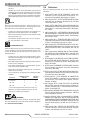
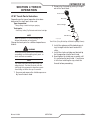
Gouging Parameters
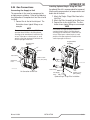
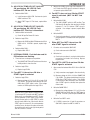
Torch Head
35°
Gouging performance depends on parameters such as
torch travel speed, current level, lead angle (the angle between the torch and workpiece), and the distance between
the torch tip and workpiece (standoff).
Standoff Height
Workpiece
A-00941_AB
Gouging Angle and Standoff Distance
CAUTION
Standoff Distance
Touching the torch tip or shield cup to the
work surface will cause excessive parts
wear.
Torch Travel Speed
The tip to work distance affects gouge quality and depth.
Standoff distance of 1/8 - 1/4 inch (3-6 mm) allows for
smooth, consistent metal removal. Smaller standoff distances may result in a severance cut rather than a gouge.
Standoff distances greater than 1/4 inch (6 mm) may result
in minimal metal removal or loss of transferred main arc.
NOTE
Slag Buildup
Refer to Appendix Pages for additional information as related to the Power Supply used.
Optimum torch travel speed is dependent on current setting, lead angle, and mode of operation (hand or machine
torch).
Manual 0-4988 Slag generated by gouging on materials such as carbon and
stainless steels, nickels, and alloyed steels, can be removed
easily in most cases. Slag does not obstruct the gouging
process if it accumulates to the side of the gouge path.
However, slag build - up can cause inconsistencies and
irregular metal removal if large amounts of material build
up in front of the arc. The build - up is most often a result
of improper travel speed, lead angle, or standoff height.
OPERATION
4T-7