1
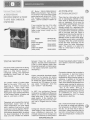
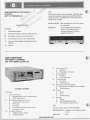
Improved Power Switch
ATTENTION
INSTRUMENTATION
TAPE RECORDER
OWNERS
HP Model 3964Al3968Al8864Al
8868A Instrumentation Tape Recorders received a new push button power
switch starting with serial prefix 1706A.
This change is described in Service
Note 3964A-613968A-718864A-61
8868-7.
If your machine has one of the older
toggle switches and it fails, you can
order a new pushbutton type with a
higher surge current rating from the
following list.
Model
3964A
3964A-009,8864A
(white panel)
3968A
3968A-O09,88$8A
(white panel)
THINK METRIC
Part of the metric system we are facing
involves temperature measurement.
Here is a little history lesson in
Centigrade, Celsius, and, Fahrenheit
provided by Andr6 Rude, HP Santa
Clara Division.
Our present variety of scales dates
back to the early 1700’s and the
beginning of modern temperature
measurement. Then there were
roughly as many scales as there were
people who knew how to measure.
Among them were Gabriel Fahrenheit,
a Pole; Anders Celsius, a Swede; and
later on, Lord Kelvin, a Briton.
Fahrenheit, who invented the mercury
thermometer, based “zero” on the
lowest temperature he could obtain
with a mixture of salt and ice, which
turned out to be 32 degrees (Fahrenheit) below the freezing point of water.
As a second referencepoint, he picked
the blood temperature of the human
body and then divided the distance
HP Part No.
03964-60060
03964-60061
03968-60060
03968-60061
between these two points in 96
degrees. (Actually blood temperature
is two or three degrees higher than
Fahrenheit reckoned, but inaccuracies
in his original instrument caused this
discrepancy.)
Celsius, meanwhile, developed a scale
defined by the freezing and boiling
points of pure water at sea level. Since
he divided the space between these
two points into 100 degrees, the scale
was called “Centigrade” (from the
Latin “centurn”-one hundred).
In 1927, the multination General
Conferenceon Weights and Measures
defined an international temperature
scale which was, in fact, the Centigrade system. In the meantime, the
Fahrenheit scale had come into common use in England and the United
States.
Centigrade became Celsius at the
1948 meeting of the General Conference, a difference in name only. The
principal reasons for the change were
a desire for uniformity (in some parts of
WWW.HPARCHIVE.COM
AUTOMATIC
AUTORANGING?
There may be a time when you might
use an autoranging voltmeter on the
ohms scale to measure front-to-back
ratio on transistors. All at once the
meter begins switching back and forth
between ranges. What’s wrong?
Actually nothing. It’s a peculiarity that
sometimes takes place when measuring a diode device (transistor junction)
with a non-inear load line. What is
happening is that since the load line is
not linear, and the meter puts out a
different current on each ohms range,
the voltage1current ration is constantly
changing. When the current becomes
excess the meter autoranges. As the
current drops the meter autoranges
again. The solution is to switch the
meter to a fixed scale or change to a
multi-meter.
EuroDe it was already called “Celsius”)
and a desire to honor the originator of
the scale.
Comparison between the two scales is
not necessary in learning Celsius
temperature, just learn a handful of
temperatures which become points of
reference. In addition to the freezing
(0°C) and boiling points (100°C) of
water, know what the temperature is on
a typical early morning for where you
live; it couldbe 10°C in the summer and
-5°C in the winter. 20°C is a
comfortableroom temperature; 30°C is
getting warm and about time to turn the
air conditioning on. 37°C is normal
body temperature; 40°C for body
temperature is alarming.
Get a metric thermometer and place it
by your desk or outside and estimate
the temperature at different times of
the day. It is an easy way to start to
think metric. Always remember that it’s
best not to convert back to Fahrenheit.
Learn your temperature in Celsius and
stick with it.
a