1
4.4
4.4
Commands
4–7
Commands
This section provides syntax and operational descriptions for remote
commands.
4.4.1
Command syntax
The four letter mnemonic (shown in CAPS) in each command sequence specifies the command. The rest of the sequence consists of
parameters.
Commands may take either set or query form, depending on whether
the “?” character follows the mnemonic. Set only commands are
listed without the “?”, query only commands show the “?” after the
mnemonic, and optionally query commands are marked with a “(?)”.
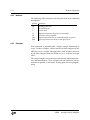
Parameters shown in { } and [ ] are not always required. Parameters
in { } are required to set a value, and should be omitted for queries.
Parameters in [ ] are optional in both set and query commands. Parameters listed without surrounding characters are always required.
Do not send ( ) or { } or [ ] as part of the command.
Multiple parameters are separated by commas. Multiple commands
may be sent on one command line by separating them with semicolons (;) so long as the input buffer does not overflow. Commands
are terminated by either hCRi or hLFi characters. Null commands
and whitespaces are ignored. Execution of the command does not
begin until the command terminator is received.
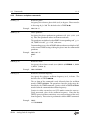
tokens Token parameters (generically shown as z in the command descrip-
tions) can be specified either as a keyword or as an integer value.
Command descriptions list the valid keyword options, with each
keyword followed by its corresponding integer value. For example,
to set the reference mode to internal, the following two commands
are equivalent:
FMOD INTERNAL
—or—
FMOD 1
For queries that return token values, the return format (keyword or
integer) is specified with the TOKN command.
SR124
Analog Lock-In Amplifier