1
Aerosol fire-extinguishing systems for fire protection in
enclosed compartments containing electrical components
PRODUCT SPECIFICATION
The system consists of the following components:
1.
Fire-extinguishing component (FEC) containing:
a.
Aerosol fire-extinguishing component for extinguishing;
b.
Fire alarm extinguishing station for driving the aerosol fire-extinguishing component and other drivers;
c.
Detection component for monitoring and guarding the object.
2.
Signal repeater (HUB)
3.
Alarm management system with radio interface
The maximum combined number of fire-extinguishing components (FEC) and signal repeaters (HUB) within one system is 511. Within a
system configuration the transmission path between a fire-extinguishing component and the alarm management system is limited to a
maximum of 32 signal repeaters (HUB). The system has to communicate on a licence-free frequency band (ISM frequency) for which
wireless communication for alarm purposes is permitted. The aerosol fire-extinguishing system should be constructed in such a way
that the radio connection as transmission path is carried out redundantly.
The system is tested and proven in the following dimensioning and projection. These dimensioning and projection fall within the scope
of the product certificate. The number of fire-extinguishing components (FEC) needed for a specific object also determines the
projection, i.e. the position and direction in which the FEC’s must be mounted. When applying 1 FEC it will be placed in the middle of
the object on the upper side, having the outflow openings pointing to the left and the right. Ensure that both outflow openings of the
FEC have at least 15 cm of free outflow space in order to prevent damage to equipment. The antenna has to be connected to the FEC
by means of an antenna extension cord. When applying 2 or more FEC’s these are placed on the side of the object to be protected,
having the outflow openings pointing upwards and downwards. Ensure that both outflow openings of the FEC have at least 15 cm of
free outflow space in order to prevent damage to equipment. When applying more than 1 FEC in a cabinet these must be linked by
means of a bus connection.
The FE is tested under following conditions to determine if detection is within the requirements of guideline BRL-K21014. The following
conditions have been used:
•
TF1, wood crib (source 7 according to BS 5852-2:1990).
•
TF4, polyurethaan mats (comparable with NEN 2535:1996 and EN 54-7:2000).
•
TF7, methylated spirit 85% (comparable with NEN 2535:1996).
•
TF10, print with 5 resistors (comparable with NEN 2535:1996).
APPLICATION AND USE
Full title
The full title of this evaluation guideline is the Kiwa product certificate for aerosol fire-extinguishing systems with wireless
communication to an alarm management system for fire protection in enclosed compartments containing electrical components
(maximum 1500 Volts DC and 1000 Volts AC).
Product aim
The aerosol fire-extinguishing system should monitor the environment to be protected for fire phenomena by detecting these
and then communicate with other equipment within the system with the purpose to alarm in an initial phase of fire, notify a
receiving station for fire alarms, extinguish in the fire phase and control during a set period.
The application is primarily meant for objects that cannot be entered by humans and fall under the definition “un-enterable
room”.
More specifically the objective is as follows:
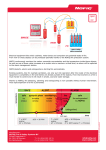
Early detection (with wireless fire alarm system with detection based on % CO and ΔT/Tmax) for fire sizes as stated in
appendix 15. The extinguishing system should prevent an expansion of the fire outside the cabinet during the standing time of
the extinguishing agent.
Evaluation Guideline
© Kiwa N.V.
- 46 -
BRL-K21014/04
June15, 2009