1
The main power rocker switch/circuit breaker tripped to the lower (off) position
while the system was playing.
You may have exceeded the maximum current capacity of the Niagara 7000. This should be rare, but it may be
possible. Typical power amplifiers draw about one-third of their maximum current consumption at 120VAC, as listed
in the product’s specifications (typically found in their owner’s manual). This is further complicated by the fact that
the power consumption to AC outlet group one (banks 5 and 6) and two (banks 3 and 4) is an additional draw on the
maximum current capacity of 20 amps that will trip this switch/magnetic circuit breaker.
The Transient Power Correction Circuit may also contribute to the overall draw seen by the circuit breaker. Still,
it should be rare that the total capacity is exceeded, but, given that some televisions, projectors, and power
amplifiers can draw substantial current, it is certainly not impossible. If this is the case, an additional Niagara 7000
or Niagara 5000, and a discrete 15- to 20-amp AC service on the same phase of the electrical panel, will be required
for some or all of the power amplifiers.
When a component was plugged into one of the Ultra-Linear Dielectric-Biased
Symmetrical Power outlets and switched on, the main power rocker switch/circuit
breaker tripped to the lower (off) position.
You have likely tripped the GFCI circuit (ground fault protection). This circuit ensures that even in the event of a
catastrophic failure to the connected components’ power supply and/or circuits (demonstrated by full shorting and
possible smoke), there will be no AC voltage on the components’ chassis that could possibly shock a person. This
circuit instantly recognizes if there is more than 5mA of current leakage from Line to AC Ground, or Neutral to AC
Ground. This is the maximum current allowed for ALL 8 of the Symmetrical AC outlets. If this current leakage is
detected, the main power switch/magnetic circuit breaker will immediately switch off, thus protecting the system
operator and all others that might come in contact with the system.
It is very rare for this circuit to trip. If it does, the connected component that causes this is either defective (most
likely), or it (and possibly another component on the same Symmetrical Power bank) may have a combined
current leakage to ground that exceeds 5mA. Technically, this is not allowed in modern electronic circuit design,
but that does not necessarily mean an otherwise well-performing product with an “unconventional” power supply
is unsafe to use. Such a component may need to be used with either the Niagara 7000’s high-current AC outlets,
which do not utilize the GFCI protection circuit, or they may be powered by another discrete AudioQuest Niagara
Series power product, thus preventing the GFCI nuisance tripping.
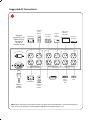
As a final check, inspect the GFCI test button on the left side of the Niagara 7000’s front panel. It is a momentary
switch and it will not latch; by pressing it lightly into the chassis, it will activate the GFCI protection circuit and
trip the main power switch/magnetic circuit breaker. Though extremely rare, it is possible that the switch could
be stuck in an “on” position from taking a blow during shipping. (The rest of the unit may be perfectly fine, but
the tolerance of this test button switch to the chassis and front panel is tight.) When pressed, the switch should
exhibit some “travel” or “give” and should not feel binding in any way. If the switch feels tight or stuck, there may
be a problem. (This will require servicing, so please be certain.)
My power amplifiers sound muddy, compressed, or weak.
The Transient Power Correction Circuit may not be operating. Be sure that all power amplifiers, powered receivers,
powered loudspeakers, and or powered subwoofers are plugged into the High Current/Power Correction
AC outlets. If any of these are plugged into the Ultra-Linear Dielectric-Biased Symmetrical Power outlets, the
connected power amplifier(s) will be current compressed, as the impedance is too high for any power amplifier.
If the power amplifier(s) are plugged into the High Current/Power Correction AC outlets, make certain that the
rear-panel Power Correction switch is in the “Engaged” position. Although it is possible for the Power Correction
Circuit to work properly while the switch is in the “Bypass” position (see “Power Correction Switch,” p.12), you
might find that the unit sounds substantially better in the “Engaged” position. If this is the case, it is possible that
17