1
FAQ
Question
Answer
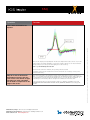
There are 175 samples per analyzed impulse. We take each sample from the start to the zero-cross for the
head movement. We sum the amplitudes of each of these samples. This gives us one value for the head.
We repeat the process for the eye movement giving us one value for the eye.
Gain = eye-sum divided by the head-sum.
Note that for the sake of this calculation, the eye tracing is first de-saccaded.
In summary, our present gain calculation is based on area under the (de-saccaded) eye velocity vs area
under the head velocity.
Why do we not tilt the head for
head impulse testing so that the
semi circular canals will be straight
like when one walks. Should we
tilt the head to compensate for the
angle of the canals?
The horizontal canal planes are pitched up just a little in the head (by about 21 degrees - Curthoys et al
1977). So to get them exactly horizontal you would have the head pitched down by 21 degrees. But it does
not really matter because the strength of the stimulus decreases as a cosine function of head pitch. So
being 20 degrees off has hardly reduced to strength of the stimulus to the horizontal canals.
For more information please read and see Figure 2: Curthoys I.S., Blanks H.I. & Markham C.H. (1977)
SEMICIRCULAR CANAL FUNCTIONAL ANATOMY IN CAT, GUINEA PIG AND MAN Acta Otolaryngol 83:
258-265.
GN Otometrics, Europe. +45 45 75 55 55. info@gnotometrics.dk
GN Otometrics, North America. 1-800-289-2150. sales@gnotometrics.com
www.otometrics.com www.icsimpulse.com
Specifications are subject to change without notice. Copyright © GN Otometrics. 2012/08. 7-26-8801-EN/04. Part no. 7-26-88001-EN.
How is Gain calculated for ICS
Impulse?