1
2.3
RAID Levels
2.3.1
Disk Striping (RAID 0)
Striping is a performance-oriented, non-redundant data mapping technique. While Striping is discussed as a RAID Group type,
it is does not provide any fault tolerance. With modern SATA and ATA bus mastering technology, multiple I/O operations can
be performed in parallel, enhancing data throughput. Striping arrays use multiple disks to form a larger virtual disk. The figure
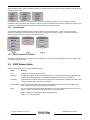
below illustrates a three-disk stripe set. Stripe one is written to disk one, stripe two to disk two, and so forth. RAID 0 sets can
be comprised of two, three, or four drives.
Stripe0
Stripe1
Stripe2
Stripe3
Stripe4
Stripe5
Stripe6
Stripe7
Stripe8
Stripe9
Stripe10
Stripe11
2.3.2
Disk Mirroring (RAID 1)
Disk mirroring creates an identical twin for a selected disk by having the data simultaneously written to two disks. This
redundancy provides instantaneous protection from a single disk failure. If a read failure occurs on one drive, the system reads
the data from the other drive. RAID 1 sets are comprised of two drives. A third drive can be allocated as a spare in case one
of the drives in the set fails.
Block 0
Block 1
Block 0
Block 2
Block 1
Block 3
Block 2
Block 3
2.3.3
Disk Mirroring and Striping (RAID 10)
RAID 10 combines the features of both RAID 0 and RAID 1. Performance is provided through the use of Striping (RAID 0),
while adding the fault tolerance of Mirroring (RAID 1). The implementation of RAID 10 requires four drives. The drives are
assigned as two sets of striped pairs.
The data is written to RAID Group A, which is striped (RAID 0). This allows maximum speed. The data is then mirrored to
another RAID 0 striped set, which is Set B in the figure above. This provides data redundancy (RAID 1), and thus increased
data security.
Under certain circumstances, a RAID 10 set can sustain multiple simultaneous drive failures.
2.3.4
Parity RAID (RAID 5)
Parity or RAID 5 adds fault tolerance to Disk Striping by including parity information with the data. Parity RAID dedicates the
equivalent of one disk for storing parity stripes. The data and parity information is arranged on the disk array so that parity is
SATARAID5 User’s Manual
Copyright © 2004 Silicon Image Inc.
7